





ECMS Approvals Boost India’s Electronics Manufacturing Push with ₹61,671 Cr Investment
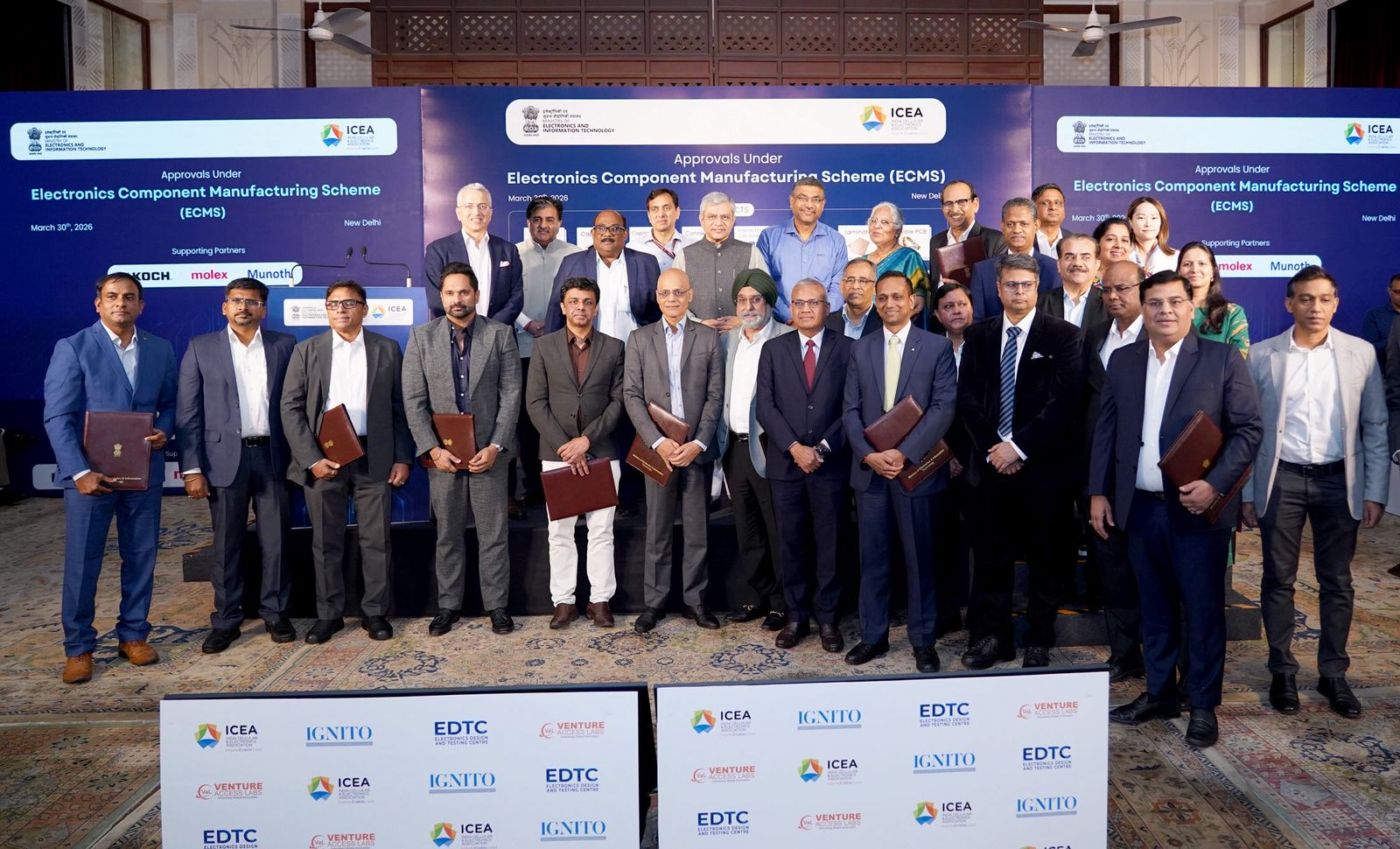
India’s electronics manufacturing ambitions have taken a decisive step forward with the Ministry of Electronics and Information Technology (MeitY) approving 29 additional proposals under the Electronics Components Manufacturing Scheme (ECMS). With a projected investment of ₹7,104 crore and expected production output of ₹84,515 crore, the latest round of approvals builds on the earlier clearance of 46 applications worth ₹54,567 crore, collectively reinforcing the government’s intent to deepen domestic value chains and reduce import dependence in a strategically critical sector.
At a structural level, the significance of this move lies not merely in incremental capacity addition, but in addressing one of India’s long-standing gaps in electronics manufacturing: component-level self-reliance. While India has made notable strides in mobile assembly under the Production Linked Incentive (PLI) scheme, a substantial portion of high-value components has continued to be imported. The ECMS approvals directly target this vulnerability by catalysing investments across 16 product categories that cut across mobile manufacturing, telecom, consumer electronics, automotive systems, strategic electronics and IT hardware.
The approved proposals span a wide spectrum of the value chain. These include sub-assemblies such as display modules, alongside 11 critical bare components including antennas, capacitors, connectors, heat sinks, lithium-ion cells, relays, resistors, transducers, SMD passives, flexible PCBs and inductors. In addition, supply chain enablers such as laminates, metallised films for capacitors and rare earth permanent magnets have also been included, along with capital goods and their components. This breadth indicates a deliberate policy shift towards building a more integrated and resilient manufacturing ecosystem rather than isolated production clusters.
Notably, several of these approvals mark first-of-their-kind investments in India. These include the country’s first SMD passive plant for tantalum-based capacitors, its first flexible PCB manufacturing facility and the first rare earth permanent magnet plant. Each of these segments is critical for high-end electronics and strategic industries, and their localisation could significantly enhance India’s position in global supply chains, particularly at a time when geopolitical realignments are prompting companies to diversify sourcing bases.
From an employment standpoint, the 29 newly approved projects are expected to generate 14,246 direct jobs. Taken together with earlier approvals, the ECMS has now cleared 75 applications with a cumulative projected investment of ₹61,671 crore and direct employment potential for over 65,000 individuals. Beyond direct jobs, the multiplier effects across ancillary industries, logistics and services are likely to be substantial, especially in industrial clusters where such facilities are established.
Union Minister for Electronics and IT Ashwini Vaishnaw has outlined a clear strategic framework to guide this next phase of growth. His emphasis on building in-house design capabilities reflects a recognition that long-term competitiveness will depend on intellectual property creation and not just manufacturing scale. Equally important is the push for a robust domestic supply chain, supported by coordinated buyer-seller ecosystems and potential preference for indigenous capital equipment manufacturers. This approach signals a move towards a more self-sustaining industrial architecture, reducing exposure to external shocks.
Quality and workforce readiness form the other two pillars of this strategy. The call for industry-wide adoption of Six Sigma standards underscores the need to align Indian manufacturing with global benchmarks, particularly as export competitiveness becomes a priority. Meanwhile, the proposal to establish multiple training centres, each capable of skilling at least 5,000 individuals, highlights the urgency of building a future-ready workforce that can support advanced manufacturing processes.
From an industry perspective, the response has been broadly optimistic. S. Krishnan, Secretary, MeitY, has pointed to the strong interest from industry and the government’s ability to match it with faster approvals. However, he has also made it clear that the onus now shifts to companies to execute projects with speed and discipline. His emphasis on opportunities in capital equipment and upstream supply chains reflects an understanding that deeper localisation will require sustained private sector participation across the value chain.
Pankaj Mohindroo, Chairman of the India Cellular & Electronics Association (ICEA), has highlighted the alignment between ECMS and the broader policy ecosystem, particularly the enhanced outlay of ₹40,000 crore announced in the Union Budget. Backed by the demonstrated success of the PLI scheme in mobile manufacturing, the expanded ECMS framework is expected to accelerate the transition from assembly-led growth to value-added manufacturing.
From a risk and resilience standpoint, the timing of these approvals is particularly significant. Global electronics supply chains continue to face disruptions driven by geopolitical tensions, trade restrictions and concentration risks in specific regions. By investing in critical components such as rare earth magnets and advanced PCBs, India is not only strengthening its domestic ecosystem but also positioning itself as a credible alternative in the global supply chain matrix.
At a time when geopolitical uncertainties and export headwinds continue to weigh on global trade dynamics, these approvals offer a timely signal of resilience. They reinforce a clear policy intent that, despite external disruptions, India’s manufacturing momentum will not stall and the wheels of industrial growth must continue to turn.
Ultimately, the ECMS approvals represent more than a policy milestone; they signal a strategic recalibration of India’s manufacturing trajectory. The focus is shifting from scale to depth, from assembly to innovation and from dependence to resilience. The real test, however, will lie in execution. If the approved projects are implemented with speed and aligned with global quality and cost benchmarks, India could move significantly closer to its ambition of becoming a global electronics manufacturing hub.