




Automation Without Readiness: The Real Challenge Facing India’s MSME Manufacturing Sector
If you have spent enough time around factory floors, you learn something important. Industrial change rarely arrives with dramatic announcements. It begins quietly. A new machine appears in one corner of the plant. A production dashboard replaces handwritten registers. A warehouse installs scanners instead of paper dispatch slips. And before anyone fully realises it, the way manufacturing works has fundamentally changed.
Over the past two decades, India’s manufacturing sector has experienced several such transitions. In the early 2000s, the first digital shift arrived through enterprise resource planning (ERP) systems that connected procurement, inventory and accounting. A few years later, the language of lean manufacturing, Six Sigma quality control and global supply chains entered factory meetings. Manufacturers began talking about reducing waste, optimising inventory and building export-oriented production. Today another transition is underway, and it may be the most consequential one yet.
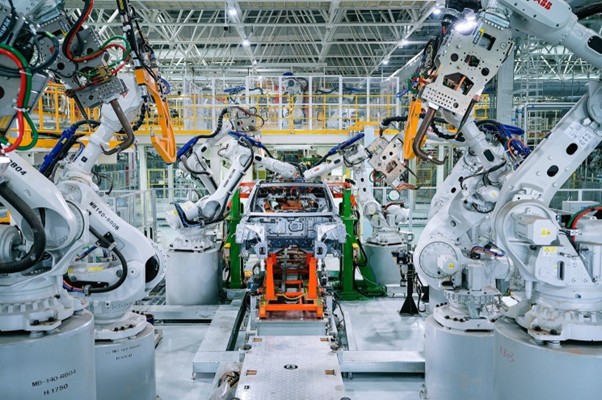
Across factories and warehouses, artificial intelligence in manufacturing, industrial automation, robotics, and predictive maintenance systems are slowly reshaping how production happens. Analysts often group these changes under the label Industry 4.0, but on the ground the transformation feels far less abstract. It shows up in the form of robotic arms assembling components, machine vision systems checking product quality and software platforms analysing production data in real time.
Yet the biggest challenge facing Indian manufacturers today is not the technology itself. Machines can be purchased. Software can be installed. The real challenge is preparing factories and people to work with them.
Put simply, the real risk lies in the widening gap between digital capability and operational readiness.
The Automation Wave Is Coming Fast
The shift toward automation is no longer limited to large multinational plants. According to a survey conducted by PwC, automation across manufacturing operations globally is expected to more than double by 2030. Even mid-sized manufacturers are exploring robotic process automation, automated warehouses and AI-based quality inspection systems.
The reasons are easy to understand. Global competition is intensifying. Export markets demand consistent quality. Supply chains must respond faster to disruptions. Automation promises efficiency, accuracy and speed but technology alone does not transform factories.
Many Indian MSME manufacturers still operate in environments where production processes rely heavily on manual intervention. Machines may exist, but data often travels through spreadsheets or paper logs. Maintenance teams fix equipment only after breakdowns occur. Warehouse inventories are updated at the end of the day rather than in real time. Introducing automation into such environments can feel like installing a jet engine on a bicycle.
The China Benchmark
To understand what readiness looks like, one only needs to look at China’s manufacturing ecosystem.
Over the past decade, China has systematically invested in smart factories and industrial automation clusters. Cities like Shenzhen, Dongguan and Suzhou host manufacturing zones where robotics, AI and digital supply chains operate together at scale.
Take the example of appliance giant Midea, whose production facilities increasingly rely on robotic assembly systems and automated inspection technology. Or Foxconn, which has deployed thousands of industrial robots to handle repetitive assembly tasks across its electronics manufacturing operations.
The real advantage China built was not simply early adoption of robots. It was the preparation of the surrounding ecosystem. Reliable power infrastructure, advanced logistics networks, skilled automation engineers and coordinated supply chains allowed automation to function smoothly.
India’s Moment and Its Constraints
India today stands at a critical manufacturing moment. Government initiatives such as Production Linked Incentive (PLI) schemes, infrastructure investments and supply chain diversification are strengthening the country’s industrial outlook.
Sectors like electronics manufacturing, automotive components, pharmaceuticals and specialty chemicals are attracting new investment. Warehousing and logistics are also evolving rapidly as e-commerce and export manufacturing expand.
Yet automation adoption across India’s MSME manufacturing base still faces three persistent challenges.
The first is infrastructure readiness. Automation systems depend on stable electricity, reliable internet connectivity and efficient logistics networks. Many smaller industrial clusters are still catching up on these basics.
The second challenge is the manufacturing skills gap. India needs more robotics technicians, automation engineers and industrial data specialists. Installing a robotic system is only the beginning. Maintaining and optimising it requires specialised expertise.
The third challenge is capital confidence. Automation investments often require significant upfront expenditure, and MSME owners understandably want to see clear returns before committing resources.
Warehouses Are Changing Too
Interestingly, some of the most visible automation breakthroughs are not happening on factory floors but inside warehouses.
Modern logistics hubs increasingly use automated material handling systems, robotic sorting machines and AI-driven inventory management platforms. Companies like Amazon and Flipkart already operate fulfilment centres where robots assist in sorting and moving products across large storage facilities.
For export-oriented manufacturers, these logistics improvements can make a measurable difference. Faster order processing, real-time inventory visibility and lower error rates improve supply chain reliability.
Automation Is Ultimately About Speed
The real advantage of automation is about more than productivity it is speed and consistency.
Factories that integrate automation effectively can scale production quickly, maintain uniform quality and respond rapidly to market demand. Those that remain dependent on manual processes often struggle to match that pace.
However, the companies that succeed are rarely the ones that simply purchase new technology. They are the ones that prepare their organisations to use it.
They train workers. They modernise warehouse systems. They integrate machines with data platforms. In short, they close the gap between digital capability and operational readiness.
The Next Chapter for MSME Manufacturing
For India’s MSME sector, the automation conversation must move beyond machines.
It must focus on process discipline, workforce training and digital integration. Industry associations, training institutes and government programmes all have a role to play in helping smaller manufacturers navigate this transition.
Because every industrial revolution ultimately rewards the same group of people: those who adapt early.
India has the entrepreneurial energy, industrial ambition and expanding export opportunities to lead the next phase of global manufacturing. But the factories of the future will not run on technology alone. They will run on readiness.
And the manufacturers who understand that distinction today may well define the next generation of India’s manufacturing competitiveness.