




AI on the Factory Floor: Why MSMEs Cannot Afford to Wait

As India hosts the AI Impact Summit 2026, and we at SME Communities have just concluded the Manufacturing Reimagined Conference, which examined whether India’s electronics SMEs can become globally competitive suppliers within three years, the timing could not be more aligned. With the Cargo Corridors Conference approaching and set to address supply chain constraints, infrastructure gaps, compliance complexities and cross-border trade risks impacting SMEs, it is evident that artificial intelligence is no longer a peripheral technology conversation. It is a core economic lever.
At the Summit, Shri S. Krishnan, Secretary, Ministry of Electronics and Information Technology, underscored that the India AI Mission is committed to ensuring AI meaningfully impacts real sectors of the economy, particularly manufacturing MSMEs. That emphasis marks a structural shift. AI is not being positioned as an abstract innovation layer but as a productivity engine embedded in factory floors and logistics corridors.
From Efficiency to Margin Expansion
For manufacturing MSMEs, especially in electronics, automotive components, precision engineering and pharmaceuticals, unit economics remain fragile. Thin margins, working capital stress and global quality benchmarks create constant pressure. AI interventions at the shop floor level can materially shift this equation.
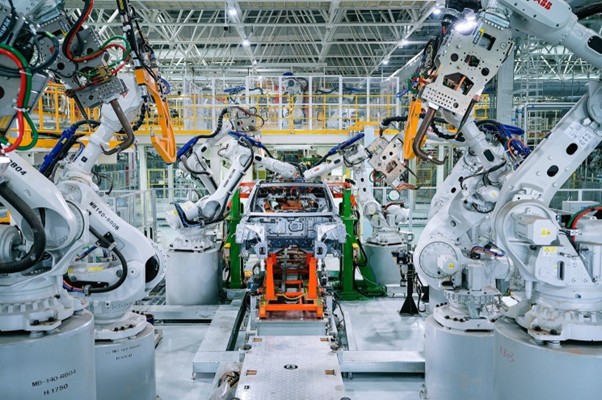
Predictive maintenance powered by machine learning reduces unplanned downtime by identifying equipment failure patterns before breakdowns occur. Computer vision systems enable automated defect detection, increasing quality consistency while reducing manual inspection costs. AI-driven production planning optimizes batch sequencing and resource allocation, minimizing idle time and material wastage.
In electronics manufacturing, where tolerance levels are tight and export certifications are stringent, AI-based quality analytics can ensure compliance traceability. This directly strengthens credibility with global buyers. For MSMEs aspiring to move from contract assembly to design-led manufacturing, AI-assisted prototyping and simulation tools shorten development cycles and enhance product reliability.
Beyond cost reduction, AI enables product-service extension. A manufacturer of industrial equipment can embed IoT sensors and use AI to provide predictive service dashboards to clients. This transforms a one-time product sale into a recurring service revenue model. Such extensions improve margins and customer stickiness, two critical factors for global competitiveness.
Rewiring Supply Chain Economics
Logistics MSMEs face their own structural challenges. Transit unpredictability, documentation errors, fuel inefficiencies and compliance complexity erode profitability. AI can intervene across the value chain.
Route optimization algorithms reduce fuel consumption and transit time. Demand forecasting models improve fleet utilization and warehouse planning. Intelligent document processing can automate trade documentation verification, reducing errors that cause shipment delays and penalties.
In cross-border trade, AI-based compliance engines can screen documentation against regulatory requirements in real time. For SMEs navigating evolving export norms, this reduces risk exposure and improves conversion rates from order to shipment.
Cargo Corridors are not merely physical infrastructure. They are data corridors. AI integrated with digital trade platforms, port systems and multimodal logistics networks can create visibility across rail, road, air and sea. For SMEs, that visibility translates into lower working capital cycles and greater reliability in global supply chains.
Material Impact on Unit Economics
The question for MSMEs is not whether AI is sophisticated, but whether it improves margins. AI interventions influence unit economics in three measurable ways.
First, cost compression through reduced waste, lower downtime and energy optimization. Second, revenue enhancement through better quality consistency, faster turnaround and service add-ons. Third, risk mitigation through predictive analytics, compliance checks and demand planning.
When aligned with structured finance and treasury discipline, AI can also support better credit profiling and cash flow forecasting, strengthening an MSME’s access to institutional capital.
India’s Emerging AI Innovators in Manufacturing and Trade
Indian companies are increasingly building AI solutions tailored to domestic industrial realities. Industrial AI startups are developing vision systems for defect detection in electronics and automotive components. Supply chain technology firms are using AI to predict port congestion and optimize container routing. Fintech and trade-tech platforms are deploying AI to reduce discrepancies in trade documentation and accelerate invoice processing.
Under the India AI Mission, the focus is shifting toward sectoral deployment rather than generic experimentation. AI innovation hubs, semiconductor initiatives and data governance frameworks are expected to further strengthen domestic capabilities.
For MSMEs, the opportunity lies in adopting contextual AI solutions rather than importing expensive, generic systems. The next phase of industrial competitiveness will depend on how effectively AI integrates with cluster ecosystems, shared testing facilities and digital public infrastructure.
AI as a Strategic Competitiveness Lever
The convergence of policy support, digital infrastructure and AI capability creates a pivotal moment. If electronics MSMEs aim to become globally competitive suppliers within three years, they must embed AI into quality control, design capability and compliance frameworks. If logistics MSMEs aim to reduce supply chain bottlenecks, AI must drive route intelligence, document automation and predictive risk monitoring.
AI will not replace entrepreneurs. It will amplify disciplined operators. The winners will be those who align AI adoption with governance maturity, financial structuring and ecosystem collaboration.
As India repositions itself in global value chains, artificial intelligence may prove to be the invisible infrastructure that determines whether scale is merely announced or structurally achieved.