




A 120-Minute Visit, a Decade-Long Signal: How India-UAE Engagement Is Rewiring Trade Corridors and Business Confidence
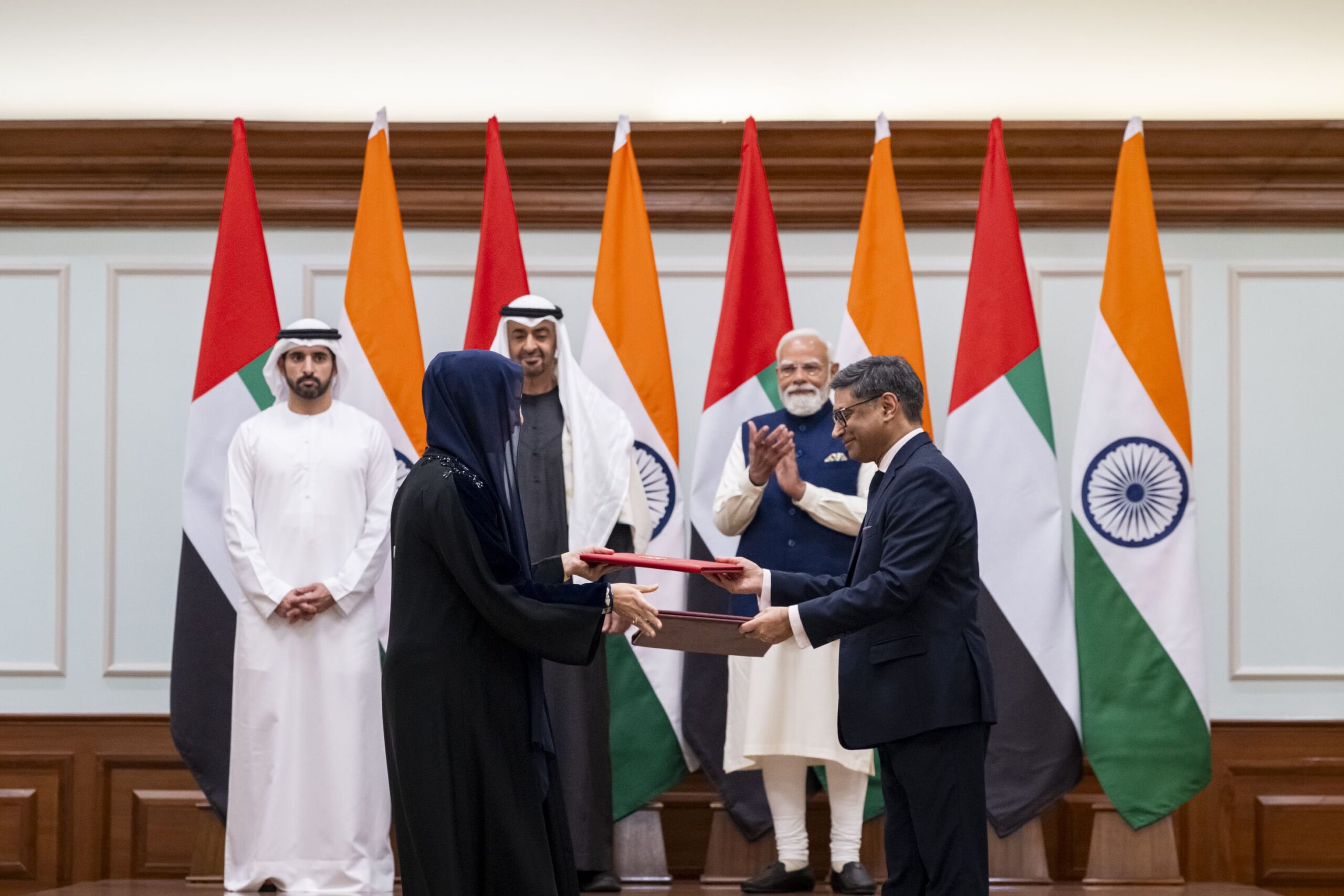
A visit that lasted barely 120 minutes has projected fresh optics on diplomacy, speed and strategic intent. The recent engagement between Prime Minister Narendra Modi and UAE President His Highness Sheikh Mohamed bin Zayed Al Nahyan was short in form but expansive in consequence. In a compressed diplomatic window, both leaders revisited the depth of a long-standing partnership and, more importantly, outlined a forward-looking agenda centred on trade corridors, investment execution and new-age business integration. The message was clear: India-UAE ties are no longer about alignment alone, but about accelerating outcomes.
From Strategic Partnership to Corridor-Driven Economics
Over the past decade, the India-UAE Comprehensive Strategic Partnership has evolved into one of India’s most commercially relevant bilateral relationships. The endorsement of outcomes from the 13th High-Level Task Force on Investments and the 16th Joint Commission Meeting signals institutional continuity, not episodic engagement. The leaders’ reference to recent visits by the Crown Princes of Abu Dhabi and Dubai adds a generational dimension, reinforcing that this partnership is being built for longevity, not political cycles.
What distinguishes the current phase is its corridor logic. Trade, capital, logistics and digital connectivity are being aligned as integrated systems rather than standalone initiatives. This reflects a shift from bilateral cooperation to corridor-based economic architecture.
Trade Momentum and the MSME Integration Agenda
Trade remains the most visible indicator of momentum. Since the signing of CEPA in 2022, bilateral trade has reached USD 100 billion in FY 2024-25. The decision to target USD 200 billion by 2032 is ambitious, but grounded in specific enablers. Central to this is the explicit focus on MSMEs. Initiatives such as Bharat Mart, the Virtual Trade Corridor and Bharat-Africa Setu are designed to plug Indian MSMEs into Middle East, West Asian, African and Eurasian markets.
For SMEs and exporters, this represents a move away from opportunistic exports toward structured participation in regional trade corridors, supported by digital platforms, logistics integration and institutional backing.
Infrastructure, Investment and the Dholera Play
Investment cooperation added strategic weight to the engagement. The Bilateral Investment Treaty signed in 2024 has already improved capital confidence, but the proposed UAE partnership in developing the Dholera Special Investment Region marks a step change. The planned infrastructure, including an international airport, MRO facilities, a greenfield port, rail connectivity and energy systems, positions Dholera as a corridor-linked industrial hub rather than a standalone industrial zone.
The Prime Minister’s invitation to UAE sovereign wealth funds to participate in the second NIIF Infrastructure Fund, scheduled for 2026, further embeds long-term capital into India’s corridor and infrastructure strategy. This is patient capital aligned with logistics, manufacturing and export competitiveness.
Financial Gateways and Payment Connectivity
The financial architecture of the partnership is also being strengthened. The establishment of DP World and First Abu Dhabi Bank operations in GIFT City reinforces its role as an international financial gateway. FAB’s GIFT City branch is expected to act as a conduit connecting Indian corporates to GCC and MENA markets, supporting trade finance, investment flows and cross-border structuring.
Equally significant is the decision to work toward interlinking national payment platforms. Faster, cheaper and more reliable cross-border payments are a critical lubricant for trade corridors, especially for MSMEs operating on tight margins and timelines.
Energy, Food and Resilience Corridors
Energy cooperation continues to underpin the relationship. The 10-year LNG supply agreement between HPCL and ADNOC Gas strengthens India’s energy security, while civil nuclear collaboration under the SHANTI Act opens pathways for advanced reactors and SMRs. These are not isolated deals; they contribute to long-term resilience corridors linking energy supply, industrial growth and sustainability.
Food security cooperation reflects a similar corridor mindset. The APEDA-UAE MoU on food safety and technical standards facilitates smoother agri-trade flows, benefiting Indian farmers while strengthening the UAE’s food resilience through diversified sourcing.
Technology, Digital Corridors and Space Economy
The future-facing dimension of the engagement lies in technology. Agreement in principle to establish a supercomputing cluster in India, in collaboration between C-DAC and UAE’s G-42, aligns with India’s AI Mission and supports research, start-ups and commercial applications. Discussions on data centres and the exploration of Digital Embassies under mutually recognised sovereignty arrangements point to the creation of trusted digital corridors.
Space cooperation, through a joint initiative between IN-SPACe and the UAE Space Agency, aims to build an end-to-end commercial ecosystem spanning launch infrastructure, manufacturing, incubation and joint missions, linking industrial policy with frontier technology.
Security, Stability and Corridor Protection
Trade corridors require stability. The signing of a Letter of Intent toward a Strategic Defence Partnership, combined with deeper counter-terror financing cooperation within FATF frameworks, reinforces the security backbone of the partnership. Defence industrial collaboration, cyber cooperation and interoperability are increasingly part of ensuring safe and reliable economic flows.
A Business-First Diplomatic Signal
Beyond deals and MoUs, the engagement reaffirmed people-to-people, education and cultural ties through youth exchanges, offshore IIT and IIM campuses, Digilocker integration and the proposed House of India in Abu Dhabi. These elements strengthen trust, which remains the soft infrastructure behind hard trade corridors.
The significance of this 120-minute engagement lies in its coherence. India and the UAE are aligning trade, investment, finance, technology and security into a single corridor-centric economic vision. For Indian SMEs, exporters and ecosystem players, the signal is unmistakable. This partnership is moving at speed, and it is increasingly about execution, access and scale. In a world where trade is being reshaped by corridors rather than borders, India–UAE ties are positioning themselves firmly on the fast lane.