




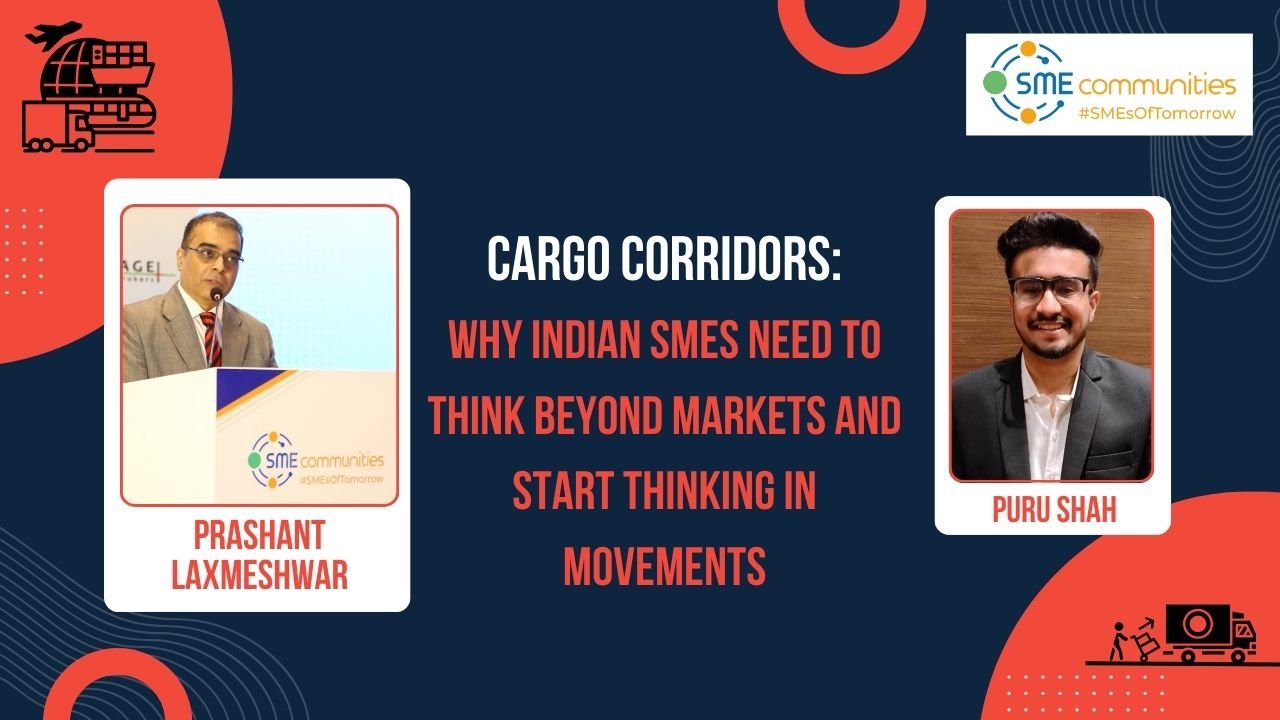
Cargo Corridors: Why Indian SMEs Need to Think Beyond Markets and Start Thinking in Movements
India’s SME export narrative has long been framed around markets, incentives, and demand cycles. Yet, as global trade becomes more fragmented, compliance-heavy, and risk-sensitive, competitiveness is increasingly determined not by where SMEs sell, but by how reliably they can move goods, money, and information across borders.
In this SME Dialogue, Puru Shah speaks with Prashant Laxmeshwar, Founder, SMECommunities, on why Cargo Corridors was conceptualised as an industry initiative, how corridor-readiness is redefining export capability and why risk-awareness is no longer optional for globally ambitious SMEs.
Puru Shah: There are many export- and logistics-focused forums in India. What gap did you see that led you to conceptualise Cargo Corridors as an industry initiative?
Prashant Laxmeshwar: Most conversations around exports still begin and end with markets, which country to sell to, what incentives exist, where demand is rising. Those are important questions, but they are no longer sufficient.
What SMEs struggle with today is not ambition; it is movement. Moving goods reliably. Moving money efficiently. Moving information securely. And doing all of this while navigating compliance, volatility, and disruption.
Cargo Corridors was born from the belief that trade competitiveness is now determined by how well an enterprise can move across corridors, not just enter markets.
You use the term “corridor-ready SMEs” quite often. What does that mean in practice?
Being corridor-ready means an SME understands that exports are not a single transaction; they are a system.
A corridor is not just a port or a shipping route. It is an integrated flow of logistics infrastructure, trade finance, customs and regulatory frameworks, digital visibility and risk management. If even one of these breaks, the corridor fails for the SME.
Cargo Corridors helps founders assess a simple but powerful question:
Are we structurally ready to move goods, money and risk across borders, consistently and competitively?
How is Cargo Corridors different from a conventional logistics or trade seminar?
Conventional seminars are often siloed. One panel talks about ports, another about finance, another about policy, each in isolation.
Cargo Corridors is designed around integration. We bring logistics providers, banks, insurers, technology players, policymakers and SME leaders into one conversation because that is how trade actually works on the ground.
We are not selling optimism. We are offering clarity on where friction really lies, where risk accumulates silently and where SMEs must build capability rather than depend on luck.
Risk seems to be a recurring theme in your narrative. How central is risk-awareness to this initiative?
Risk is not a separate topic anymore; it is the invisible layer running through every corridor.
FX volatility, delayed payments, documentation errors, cyber vulnerabilities in logistics systems, regulatory shifts like CBAM, these are not theoretical risks. They directly affect margins, reputation, and buyer trust.
Cargo Corridors integrates risk-awareness into trade conversations not to create fear, but to enable preparedness. An SME that understands risk early negotiates better, plans better and survives disruptions better.
What kind of SME founder did you have in mind while shaping this initiative?
The serious one.
Not necessarily large, but serious about quality, consistency, and long-term relevance. Founders who want to move from being opportunistic exporters to reliable global suppliers.
These founders do not want motivational speeches. They want practical insights:
-How do I reduce transit uncertainty?
-How do I protect margins from currency shocks?
-How do I ensure compliance does not become a silent deal-breaker?
Cargo Corridors speaks to that mindset.
You have described this initiative as reducing “SME anxiety.” Could you expand on that?
Many SMEs quietly carry anxiety into global trade. Anxiety about delays they cannot control, about a single mistake ruining a buyer relationship, about risks they sense but do not fully understand.
Cargo Corridors does not promise certainty, but it replaces anxiety with confidence through clarity. When founders understand how corridors function, who plays what role, and where risks originate, decision-making becomes calmer and more strategic.
That psychological shift is as important as any policy reform.
How does Cargo Corridors fit within your broader vision at Amanhã Idealabs?
It fits perfectly in sync with our broader vision. At Amanhã Idealabs, our work has always been about unravelling tomorrow, helping enterprises prepare for what lies ahead, not just respond to what has already happened.
Cargo Corridors connects seamlessly with Manufacturing Reimagined, Unwrapping Growth, and our broader risk-awareness initiatives. If manufacturing is the engine, Cargo Corridors is the circulatory system, ensuring what is produced can move reliably, profitably and responsibly across borders.
As global trade becomes more corridor-driven than market-driven, initiatives like Cargo Corridors signal a shift in how Indian SMEs must think about exports. Competitiveness is no longer defined by ambition alone, but by preparedness, integration and risk intelligence. For SME founders seeking longevity in global trade, corridor-readiness may well become the new baseline.