




The Great Convergence in Global Trade: Why Logistics, FX, Funding & Compliance Must Operate as One Workflow
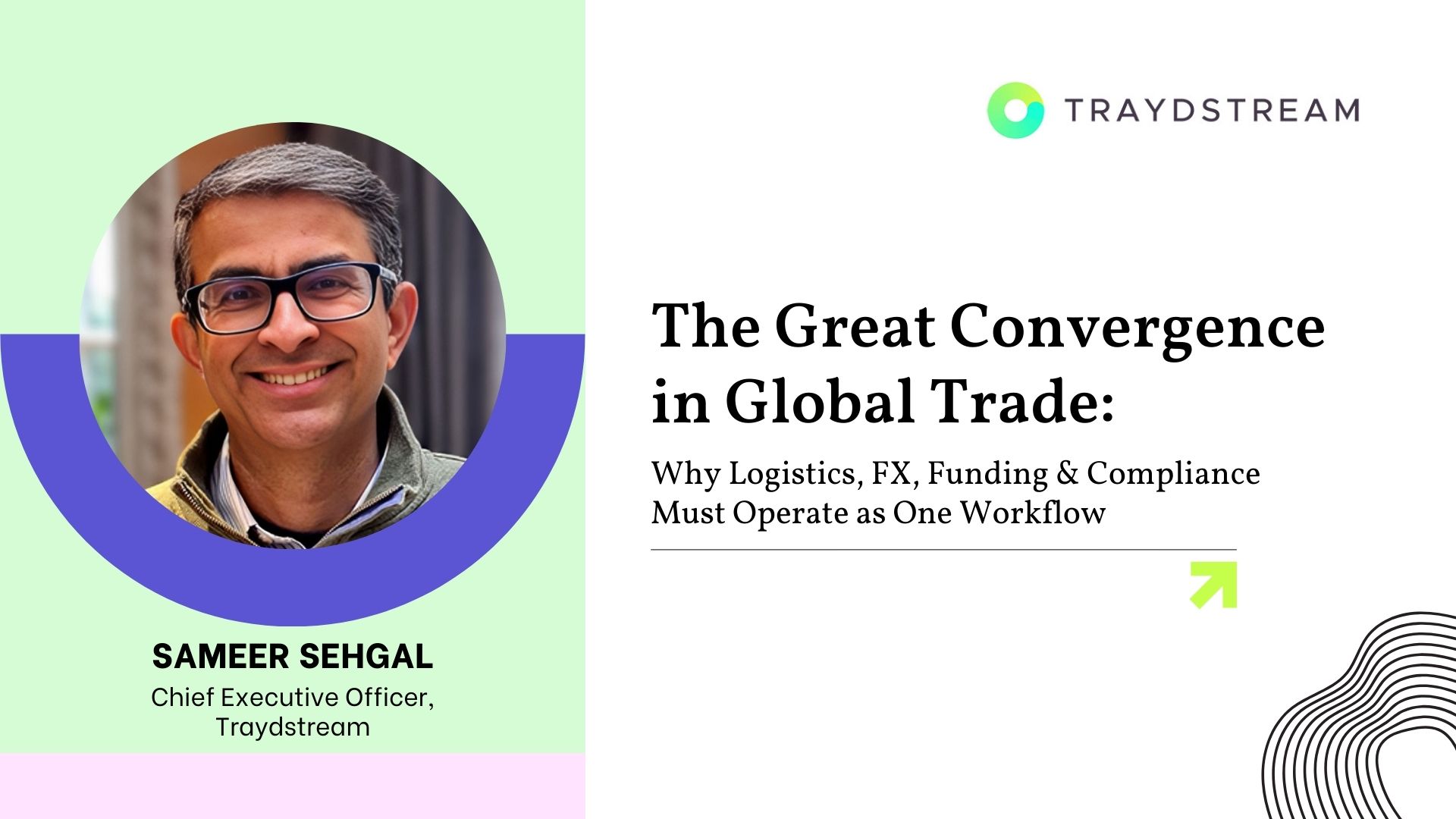
By Sameer Sehgal, Chief Executive Officer, Traydstream
For decades, global trade has operated through a series of parallel systems that rarely spoke to one another. Logistics providers moved goods. Banks processed letters of credit. Treasuries managed foreign exchange exposures. Compliance teams scrutinised documentation. Insurers assessed risk after the fact. Each function was competent within its domain. Collectively, however, they formed a fragmented architecture held together by emails, courier packages and reconciliations.
That fragmentation is no longer sustainable.
The pressures reshaping international trade are structural, not cyclical. Sanctions regimes are more dynamic. Regulatory scrutiny is more granular. Currency volatility is more frequent. Supply chains are more complex and geographically distributed. At the same time, exporters, particularly mid-sized and growth-oriented enterprises, expect speed and transparency comparable to what they experience in consumer financial services.
In this environment, incremental digitisation of isolated processes is insufficient. What global trade now requires is convergence: logistics, foreign exchange, funding and compliance operating as a single, intelligent workflow rather than as sequential hand-offs.
The traditional trade finance model was built around documents as static artefacts. Bills of lading, commercial invoices, packing lists and certificates were generated, transported and manually examined. Banks performed scrutiny against UCP and ISBP rules. Discrepancies were flagged, corrected and resubmitted. Compliance checks often occurred at separate stages, creating further delay. FX booking typically followed document approval, leaving exporters exposed to timing mismatches.
Each stage was rational in isolation. Together, they introduced friction.
Today, however, documents are no longer merely pieces of paper. They are data sets. Once treated as structured information, they can be validated against rulebooks automatically, screened in real time against sanctions lists, and analysed for anomalies indicative of trade-based financial crime. They can also trigger downstream processes, such as FX execution or financing disbursement, without requiring manual re-entry of data.
This is the essence of convergence: the transformation of trade documentation from a compliance burden into an orchestrating data layer.
In practical terms, this means embedding intelligence at the point of document creation. Exporters should know whether a presentation is compliant before it reaches the bank. Compliance checks should not be a separate department’s retrospective function but a live control embedded in the workflow. FX exposure should be visible within the same interface that manages shipping and documentation milestones. Analytics should provide banks and corporates with predictive insights into processing times, recurring discrepancies and risk concentrations.
When these capabilities are unified, the economics of trade change.
For banks, operational risk reduces as rule-based checks create consistency and auditability. Turnaround times compress because scrutiny becomes standardised and exception-based rather than entirely manual. For exporters, liquidity accelerates; fewer discrepancies mean faster negotiation and reduced cost. For regulators and compliance officers, the availability of traceable, data-driven audit trails strengthens governance. For logistics providers and insurers, access to reliable, real-time trade data enhances underwriting and risk assessment.
Importantly, convergence is not about replacing human judgment. Trade finance remains a relationship-driven business. Complex transactions require expertise. However, expertise should be focused on exceptions and structuring, not on re-keying information or manually verifying repetitive clauses.
The industry has long spoken of digitisation. What is emerging now is something more fundamental: the creation of shared infrastructure. A single access environment through which exporters, banks, compliance teams and ecosystem partners interact around the same set of validated data. In such an environment, friction does not disappear entirely, but it becomes measurable and manageable.
For growth markets in Asia, the Middle East and Africa, where trade volumes are expanding alongside regulatory complexity, this convergence may prove particularly transformative. Many mid-market exporters struggle not because of lack of demand but because of documentation errors, compliance uncertainty and delayed financing. A unified workflow reduces these barriers without diluting regulatory standards.
The next phase of global trade will therefore not be defined solely by faster ships or cheaper capital. It will be defined by integrated digital rails that align operational, financial and regulatory processes into a coherent system.
In that system, logistics is not an external event; it is a data trigger. FX is not an afterthought; it is an embedded control. Compliance is not a bottleneck; it is a continuous safeguard. Funding is not delayed by paperwork; it is activated by verified information.
Convergence does not require every institution to build identical systems. It requires interoperability, shared standards and a willingness to rethink trade as a coordinated workflow rather than a chain of disconnected tasks.
The architecture of global commerce is being rewritten. Those who recognise that logistics, FX, funding and compliance must operate together, not sequentially, will define the next chapter of trade finance.