



NBFC Growth Strategies: Capital India’s Tech-Driven, Risk-Disciplined Journey
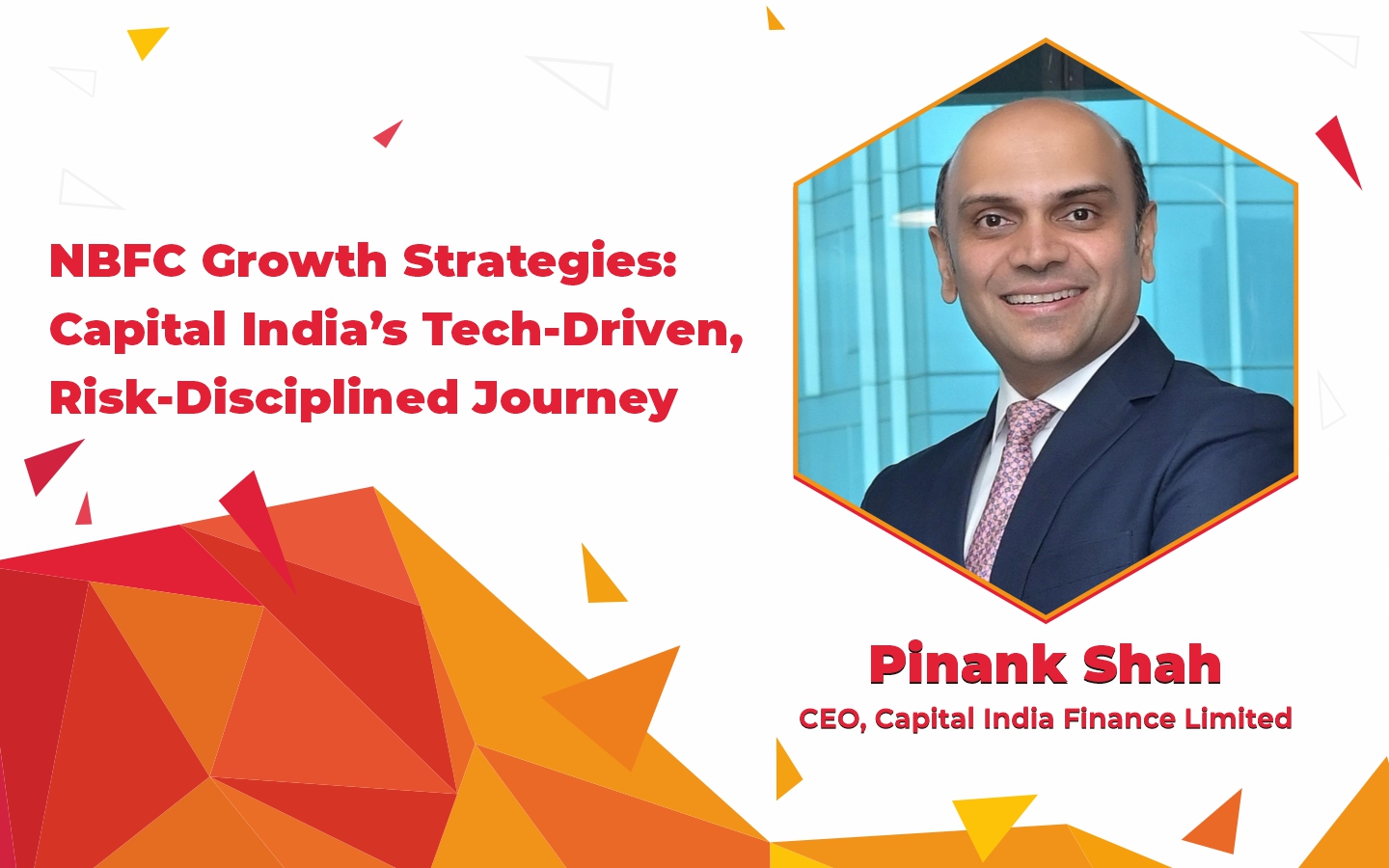
In India’s fast-evolving financial landscape, NBFCs are no longer just lenders, they are shaping the future of credit inclusion, technology adoption, and governance standards. Capital India Finance Limited (CIFL), under the leadership of CEO Pinank Shah, has been at the forefront of this transformation. From cautious consolidation to decisive growth, CIFL has crossed ₹1,000 crore in AUM while staying anchored to risk discipline and asset quality.
In this exclusive conversation, Mr. Pinank explains how CIFL is leveraging technology, governance, and ecosystem partnerships to redefine MSME lending, manage risk prudently, and scale sustainably.
What were the key challenges in transforming into a tech-driven, risk-disciplined NBFC, and how did you ensure both business continuity and regulatory compliance during this shift?
Pinank Shah: Transforming into a tech-driven and risk-disciplined NBFC required a fundamental mindset shift, both within the organization and in how we engaged with customers. One key challenge was balancing speed with stability. Digital adoption brings efficiency but also demands strong governance. Simultaneously, the regulatory environment has become far more stringent, increasing the cost of compliance.
To address this, we took a phased approach, prioritizing compliance and governance over aggressive growth in the early stages. We invested heavily in building a strong risk framework, independent credit committees and automated monitoring systems before scaling. This meant curtailing growth at times, but it ensured that we built a resilient foundation. Today, that discipline is paying off, as we scale with confidence and credibility.
How does CIFL approach credit underwriting in segments with limited formal footprints, and what role has tech played?
MSME lending is about understanding the reality of cash flows rather than just formal documents. Our approach is rooted in assessing income generation, transaction patterns, and repayment intent. With the advent of digital payments, GST records and bank statement analysis, we now have multiple touchpoints to map a customer’s real financial behavior.
Technology and data analytics allow us to build predictive models that assess risk dynamically. This reduces turnaround time for disbursals while ensuring that every loan is underwritten on strong fundamentals not assumptions.
How do you balance aggressive growth targets with prudent risk controls in Tier-II and Tier-III markets?
Our philosophy is simple: scale with discipline, not at the cost of asset quality. If you look at our numbers, our AUM was largely flat until FY24 because we prioritized risk containment over unchecked expansion. In FY25, when conditions were right and processes were mature, we scaled past ₹1,000 crore in AUM.
Additionally, we consciously reduced the share of unsecured loans and strengthened our secured lending franchise. Our teams are deeply connected to on-ground realities, allowing us to recalibrate portfolio exposure quickly if early warning signals appear. Agility and prudence go hand-in-hand for us.
How do platforms like AA, GST data and co-lending rails reshape MSME lending? Where does CIFL fit in?
The formalization of the economy through GST, Account Aggregators and digital payments has been transformational for MSME credit. These platforms give lenders like us real-time, authenticated data that improves credit visibility and reduces information asymmetry. Capital India is deeply integrated with these systems. They are no longer optional they are core to our underwriting and monitoring processes. We leverage these rails not just to assess credit but to build better customer engagement models for faster, smarter, and safer lending.
With AUM crossing ₹1,000 crore and exiting Capital India Home Loans, what’s next?
The decision to divest Capital India Home Loans was strategic, we wanted sharper focus on MSME lending and efficient capital deployment. Our next phase is about scaling distribution, building deeper customer relationships, and leveraging technology to improve productivity. We are expanding our branch footprint in high-potential markets and investing in people. At the same time, we are evaluating new product lines and co-lending arrangements to serve MSMEs holistically. The foundation is in place; now, it’s about acceleration with precision.
How are you strengthening governance, fraud prevention and early-warning systems?
Risk and governance are non-negotiable. Over the years, we have significantly strengthened our compliance framework, aligned with RBI’s enhanced guidelines. Today, most of our committees are chaired by independent directors, ensuring strong oversight and accountability. On the operational front, we have automated early warning triggers across geographies, borrower profiles and transaction patterns. This proactive approach allows us to intervene early, not react late. Governance isn’t just a function it’s part of our culture.
How is CIFL reducing its cost of capital and managing ALM?
Liability management is the lifeline of an NBFC. Over the last two years, we have diversified our lender base, added several new institutional partners and successfully completed our inaugural NCD issuance. We maintain a positive cumulative ALM gap across all buckets remaining ultra-conservative in liquidity management. Our improving credit profile, strong balance sheet and disciplined growth trajectory have resulted in a better credit rating, which in turn reduces our cost of funds. As monetary transmission continues, we expect further benefits over the next 6–9 months.
How do RemitX and RapiPay create strategic synergies with your lending business?
RemitX is a low-capital fee business that diversifies our income stream. RapiPay, on the other hand, is our technology play that plugs us directly into the merchant ecosystem at the grassroots level. It complements our core product of secured lending by giving us deep insights and access to MSMEs, enabling us to design relevant credit products Together, these platforms create a tech enabled ecosystem – making Capital India more than just a lender, an agile financial institution with the resilience and depth of a Bank.
Conclusion
Capital India Finance’s journey reflects a broader truth about India’s NBFC sector: sustainable growth comes not from chasing disbursals but from building a foundation of trust, compliance, and technological agility. By diversifying its liability base, embedding early-warning systems, and aligning with India’s formalization wave, CIFL is positioning itself as more than a lender, it is evolving into a financial solutions platform with strategic depth. As the company sharpens its MSME focus, expands its distribution footprint, and leverages synergies from RemitX and RapiPay, it offers a blueprint for how modern NBFCs can scale with precision, discipline and purpose.