




Colour with Credibility: Vipul Organics’ Journey Beyond Borders
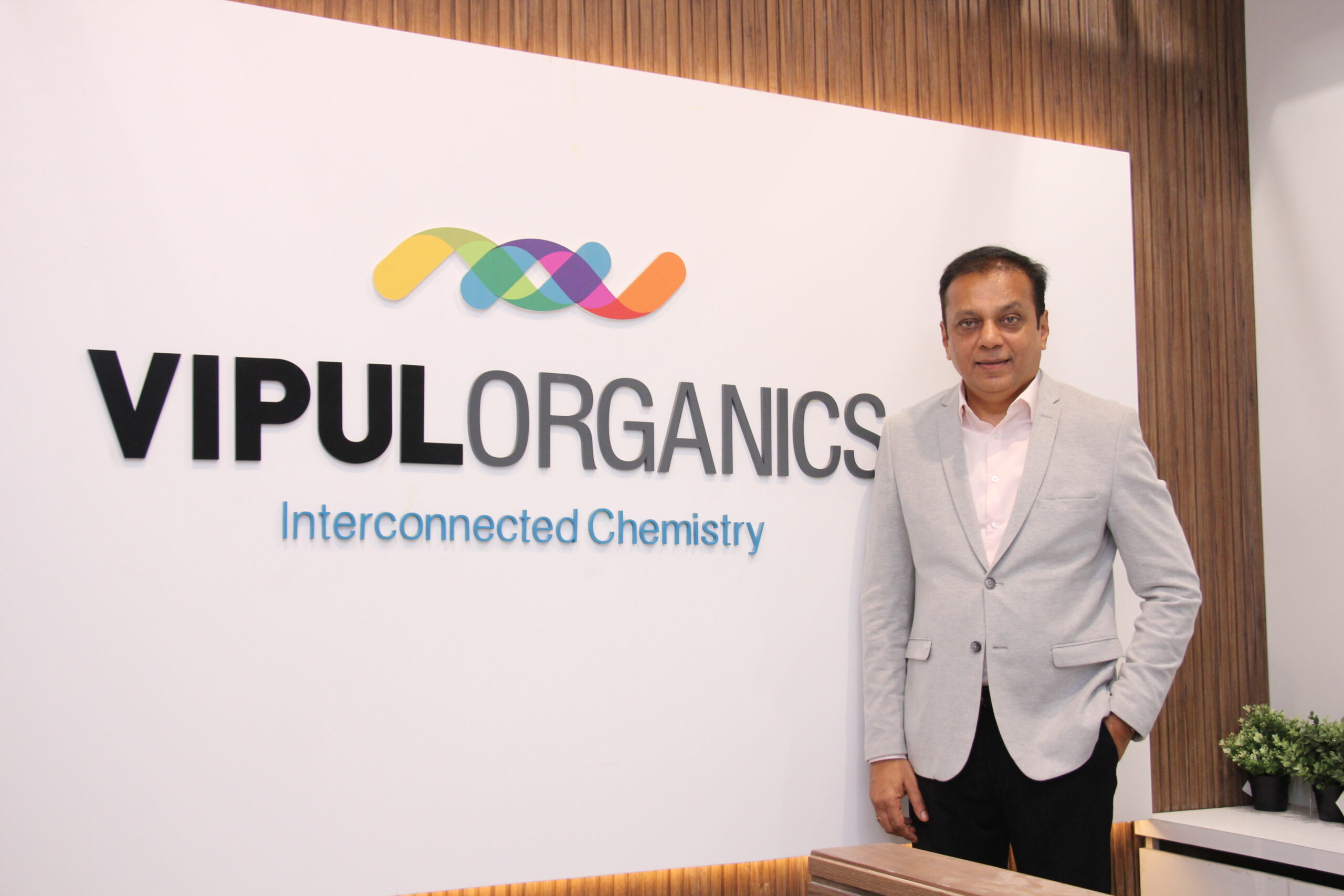
In a world where global markets demand innovation, sustainability and agility, few Indian SMEs have managed to stand out on the international stage. Vipul Organics Limited is one such success story. From its beginnings as a domestic pigment manufacturer, the company has grown into a global player, delivering high-performance, specialty colorants to over 45 countries.
We spoke with Mr. Vipul P. Shah, Managing Director of Vipul Organics, to understand how the company has leveraged innovation, digitalization and sustainability to scale globally, diversify into new markets and set new benchmarks for Indian SMEs in specialty chemicals.
Vipul Organics has grown from a domestic player to a global supplier across 45+ countries. What business strategies have been most critical in driving this scale and global presence?
Our journey from a domestic enterprise to a global supplier has been built on three strategic pillars: deep-rooted partnerships, regulatory readiness, and customized innovation. Over the years, we’ve developed a robust global distribution network that mirrors our values, consistency in quality, agility in service and integrity in relationships. Compliance with stringent global certifications such as ECOPASSPORT, GOTS, ZDHC and REACH has been instrumental in unlocking high-barrier markets like the EU, Japan and North America.
What truly differentiates Vipul Organics is our customer-centric R&D philosophy – we don’t just sell pigments; we co-create solutions with our clients. This has enabled us to build long-term, trust-based relationships, resulting in organic expansion across multiple geographies.
Innovation has been at the heart of the chemicals and colorants industry. How is Vipul Organics leveraging R&D and new technologies to stay ahead of global competition?
For us at Vipul Organics, innovation is not an isolated function; it’s woven into the fabric of how we operate. Our R&D teams work at the intersection of chemistry, customer need, and application-specific performance. A strong example is our development of an innovative organic intermediate, now approved by Japanese OEMs, who are known for their uncompromising standards.
We’ve also entered the VAT dyes segment, which broadens our product scope and application portfolio. What gives us an edge is our closed-loop R&D system, where product development, customer feedback, production feedback and compliance updates flow seamlessly into each other. This integration ensures that we’re not just keeping up with the market but staying several steps ahead.
The chemical sector is undergoing rapid transformation with sustainability and digitalization. How are these megatrends influencing your growth roadmap?
Both sustainability and digitalization are central tenets of our long-term strategy, not just checkboxes. We have already implemented Zero Liquid Discharge (ZLD) across all our manufacturing sites, a major commitment for any SME in a resource-intensive sector.
Through our group company, Adimem, we are advancing indigenous membrane technologies for industrial water treatment, a move that reinforces both our sustainability and Make in India agenda.
On the digital front, our upcoming Sayakha facility is envisioned as one of India’s most automated pigment plants, integrating real-time quality control, automated batching, digital packaging and central traceability systems. These investments help us improve efficiency, reduce waste and deliver globally compliant products with precision.
With volatility in global supply chains and raw material costs, what financial strategies help you manage risks while sustaining profitability and expansion?
Navigating global volatility requires a layered and proactive approach. We have diversified our sourcing base, entered into long-term procurement contracts, and localized parts of our supply chain where strategic, to ensure that pricing and availability do not create issues.
We also use value engineering at the formulation level to deliver the same product performance with optimized raw materials. Our inventory planning is dynamic, supported by SAP tools, allowing us to respond quickly to supply-side disruptions.
Strategic inventory planning, hedging mechanisms, and value engineering at the formulation level help us manage costs without compromising on quality. This disciplined approach allows us to remain agile, even during global disruptions.
Vipul Organics is expanding into new application areas like cosmetics, paper, and automotive. What’s the vision behind this diversification and how do you assess emerging opportunities?
Our long-term vision is to evolve into a multi-application, global colorant company, one that is not dependent on any single sector but participates across growth industries with high-value, high-performance pigments.
Each segment, be it cosmetics, automotive, paper, or plastics, brings unique challenges and opportunities. Diversification brings business resilience and continuous learning.
Our existing certifications and high-purity pigment chemistries give us a first-mover advantage in the category. We evaluate new opportunities through a strategic lens: examine global consumer trends, regulatory shifts, application technology compatibility, and margin potential. This ensures that diversification adds not just to the topline but provides strategic resilience to our offerings, giving us a competitive edge.
India is actively entering into new Free Trade Agreements (FTAs) while also pushing Make in India and MSME competitiveness. From your perspective, how can such trade agreements, along with policy and ecosystem support, help SMEs in manufacturing scale globally?
FTAs offer a tremendous opportunity for Indian SMEs to integrate into global value chains, not just as low-cost manufacturers but as value-added partners. When combined with Make in India 2.0, which emphasizes domestic capacity-building, digital adoption and sustainability, the environment is turning increasingly favourable for globally ambitious SMEs.
However, to fully leverage these FTAs, we need continued policy stability, export-friendly taxation, robust trade infrastructure and quicker regulatory approvals. If implemented well, FTAs, like those with the EU and UK, could unlock preferential access to high-value markets, reduce landed costs for our buyers and make Indian specialty chemical exporters more competitive on quality, not just price.
As a second-generation leader, how do you see leadership evolving in family-driven businesses like yours, especially in terms of digital adoption, talent management and corporate governance?
My father built this company on a strong foundation of ethics, quality and operational discipline. His leadership was grounded in deep product knowledge and relationship-building, values we still hold dear.
But today’s leadership demands a whole new toolkit: data-driven decision-making, digital fluency and a culture of innovation.
We’ve implemented SAP for operational visibility and Salesforce to streamline customer engagement, bringing accountability and agility into our processes.
From a talent standpoint, we recognize that today’s workforce seeks purpose, growth, and flexibility. We are actively investing in leadership development, cross-functional learning and creating an inclusive, performance-oriented work culture. Governance too has evolved over the years: what was once informal is now structured and transparent, with ESG principles embedded into our board-level agenda.
It is the new world order today. While my father focused primarily on the Indian market, my focus has been on global expansion, digital excellence and sustainable growth.
How do you balance sustainability with growth in a resource-intensive industry like chemicals and what role do ESG metrics play in your long-term strategy?
Sustainability and growth are not opposites; they reinforce each other when approached strategically. Our strategy is to grow through sustainable innovation and responsible manufacturing.
We’ve moved from a linear model to a circular production philosophy, using by-products wherever feasible, reducing freshwater dependence and minimizing waste. Our closed-loop water systems and ISO 14001:2015 certification ensure that environmental impact is monitored and reduced at every stage.
ESG metrics are no longer optional for us: they’re integrated into our strategy. Whether it’s reducing our carbon footprint, improving employee safety, or enhancing community engagement, we track our progress with KPIs that are both quantitative and value driven.
Looking ahead to 2030, what is your long-term vision for Vipul Organics, and what role do you see the company playing in shaping India’s global competitiveness in specialty chemicals?
By 2030, we aim to be a globally respected specialty colorant brand, recognized not just for our manufacturing capabilities, but for our R&D-driven innovation and sustainability leadership.
Our goal is to be present in over 75 countries, with green, integrated manufacturing hubs, and a global network of direct customer relationships. Our recent establishment of a distribution arm in the USA is a move in that direction, allowing us to serve international customers with greater proximity and responsiveness.
We see Vipul Organics playing a critical role in positioning India as a centre of specialty chemical innovation, moving beyond low-cost manufacturing to value-added, application-specific and sustainable chemistry solutions. Our journey is not just about expanding our business but about shaping a new narrative for Indian SMEs on the global stage.
Looking Ahead
Vipul Organics exemplifies how vision, discipline, and innovation can transform a domestic enterprise into a global leader. By seamlessly integrating customer-centric R&D, cutting-edge digital solutions, and sustainable manufacturing practices, the company is not just expanding its footprint, it’s redefining the global perception of Indian specialty chemicals.
For Indian SMEs aspiring to compete on the world stage, Vipul Organics offers a powerful blueprint: grow with purpose, innovate relentlessly and make sustainability a strategic advantage. Its journey signals a new era where Indian companies are not only participants but leaders in global high-value industries.