



India’s Industrial Production Expands 4.8% in January 2026: What the Latest IIP Data Signals for MSMEs, Banks and Industrial Strategy
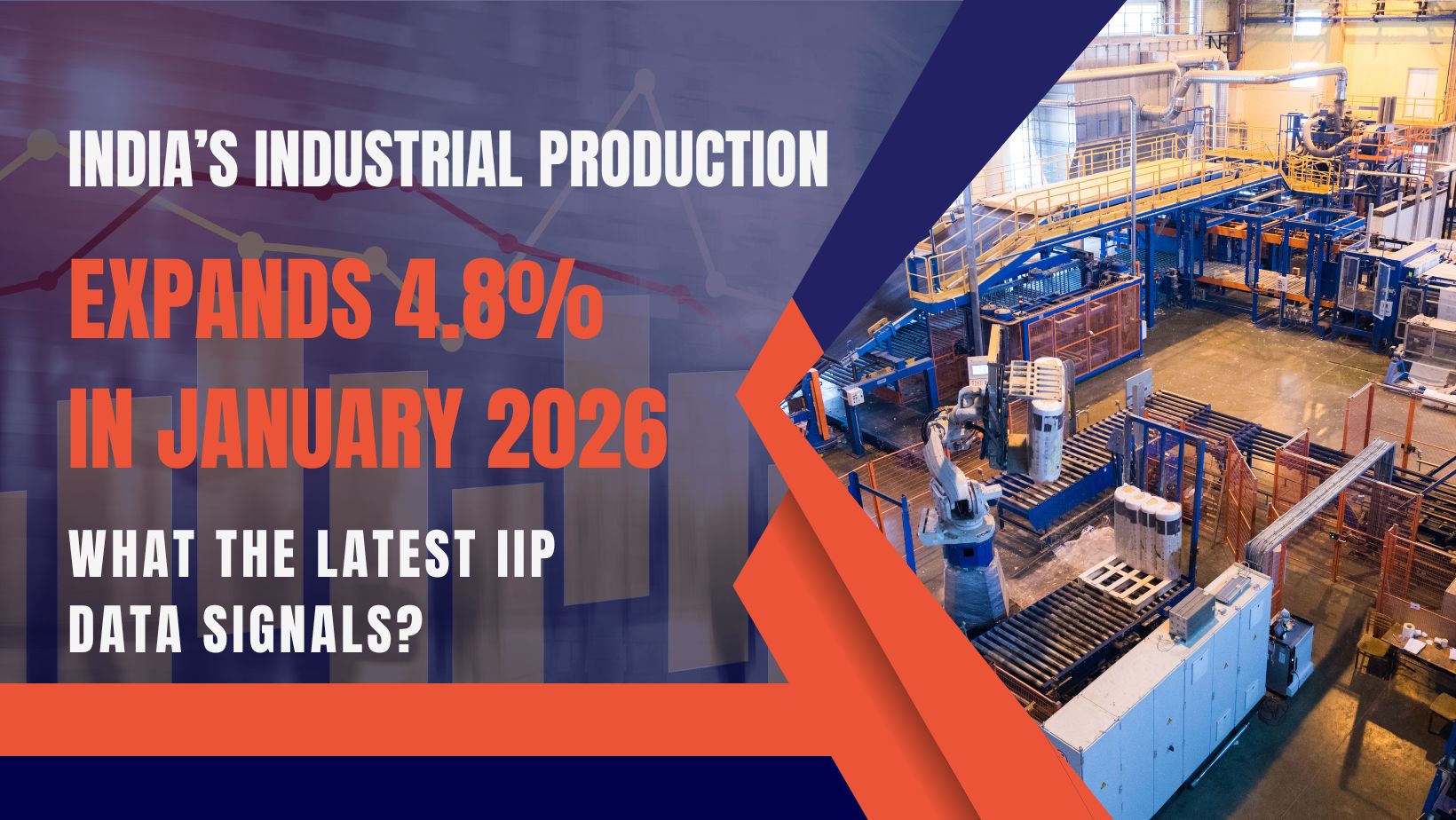
India’s industrial economy began 2026 on a stable footing, with the Index of Industrial Production (IIP) recording a 4.8 percent year-on-year growth in January 2026, according to the Ministry of Statistics and Programme Implementation. This expansion, while lower than December 2025’s revised 7.8 percent growth, reflects sustained industrial momentum anchored in manufacturing, infrastructure activity, and capital formation rather than short-term consumption surges.
The latest IIP reading, which rose to 169.4 in January 2026 from 161.6 a year earlier, provides a critical snapshot of India’s production economy. More importantly, the composition of this growth reveals structural trends that carry strategic implications for MSMEs, lenders, and technology providers serving India’s industrial ecosystem.
Manufacturing Remains the Core Driver of Industrial Expansion
Manufacturing, which accounts for over 77.6 percent of the IIP weightage, grew 4.8 percent year-on-year in January 2026, reinforcing its central role in industrial expansion. This growth reflects broad-based industrial activity, with 14 out of 23 manufacturing industry groups recording positive output expansion.
The strongest contributors came from core industrial segments:
- Basic metals grew 13.2 percent
- Motor vehicles and auto components expanded 10.9 percent
- Non-metallic mineral products, including cement, increased 9.9 percent
These sectors form the backbone of India’s industrial supply chain. Steel and metal output supports construction and infrastructure. Automotive growth signals recovery in both domestic mobility and export-linked manufacturing. Cement and mineral output reflects active infrastructure and real estate development.
Equally significant is the 18 percent growth in computer, electronic and optical products, alongside a 6.4 percent rise in electrical equipment production. These numbers indicate continued investment in industrial electrification, electronics manufacturing, and digital infrastructure, sectors closely aligned with India’s long-term manufacturing competitiveness goals.
However, the data also highlights sectoral unevenness. Textile production declined 3.7 percent and wearing apparel fell 10.3 percent year-on-year, reflecting demand pressures and export headwinds in labor-intensive sectors. This divergence reinforces that industrial growth is currently being led more by capital-intensive and infrastructure-linked sectors than consumer-led manufacturing.
Infrastructure-Linked Production Surges 13.7%, Signalling Capital Investment Cycle
One of the most important signals in the January IIP data is the 13.7 percent growth in infrastructure and construction goods, the fastest among all use-based categories.
This category includes cement, steel, construction equipment, and structural materials. Such strong growth indicates ongoing execution of infrastructure projects across roads, railways, logistics parks, energy and urban construction.
Intermediate goods, which serve as inputs for manufacturing, also grew 6 percent, while capital goods production expanded 4.3 percent. Capital goods growth is particularly significant, as it reflects investment in machinery, equipment, and industrial capacity expansion.
Together, these trends indicate that India’s industrial growth is currently being driven by investment and infrastructure creation rather than short-term consumer demand.
Electricity and Mining Growth Reinforce Industrial Activity
Electricity generation grew 5.1 percent, while mining output increased 4.3 percent in January 2026. Both sectors are foundational to industrial activity.
Electricity consumption serves as a real-time indicator of industrial operations. Rising electricity output typically reflects increased factory utilisation, logistics activity, and commercial production cycles.
Similarly, mining growth signals steady raw material supply for steel, power, and construction industries, ensuring continuity in production chains.
These indicators confirm that industrial growth is supported by actual production expansion rather than inventory adjustments or statistical distortions.
Consumer Demand Remains Uneven, Reflecting Selective Growth
While investment-linked sectors are expanding, consumer demand indicators present a mixed picture.
Consumer durables production grew 6.3 percent, reflecting steady demand for products such as appliances, electronics, and vehicles. However, consumer non-durables, which include fast-moving goods such as food products and daily essentials, contracted 2.7 percent.
This divergence suggests uneven consumption recovery, with discretionary spending recovering faster than mass consumption.
For MSMEs operating in consumer goods segments, this indicates that growth opportunities currently remain stronger in supply chain manufacturing and infrastructure-linked production rather than consumption-led sectors.
What the Data Means for MSMEs: Expansion Opportunities Exist in Supply Chains
For India’s MSMEs, which are deeply integrated into industrial supply chains, the IIP data provides actionable insights.
Growth in basic metals, machinery, electrical equipment, and infrastructure materials directly translates into increased demand for MSME suppliers providing components, fabrication, assembly, and engineering services.
MSME clusters involved in metal fabrication, industrial components, electrical assemblies, and machinery parts are likely to benefit from sustained industrial production expansion.
Conversely, MSMEs in textiles, apparel, and consumption-driven manufacturing may face continued demand volatility.
The key strategic takeaway is clear: industrial growth is currently strongest in investment-linked supply chains, not consumption-dependent sectors.
Implications for Banks and Financial Ecosystem: Credit Demand Likely to Strengthen
For banks and financial institutions, rising industrial production typically correlates with increased demand for working capital and equipment financing.
Expansion in infrastructure goods and capital goods production indicates that companies are investing in production capacity. This drives demand for term loans, equipment financing, and supply chain credit.
Improving industrial output also strengthens borrower creditworthiness by increasing revenue visibility, improving cash flows, and reducing default risk.
Financial institutions serving MSMEs can expect increased credit demand from manufacturing, infrastructure, and industrial suppliers.
Strategic Interpretation: India’s Industrial Growth Is Investment-Driven, Not Consumption-Driven
The January 2026 IIP data presents a clear strategic signal. India’s industrial growth is being driven primarily by infrastructure creation, capital investment, and industrial supply chain expansion.
This form of growth is structurally more sustainable than consumption-led growth, as it strengthens production capacity, employment generation, and export competitiveness.
With manufacturing output rising, infrastructure activity accelerating, and industrial supply chains expanding, the data confirms that India’s industrial economy is strengthening from the production side.
For MSMEs, lenders, and industrial ecosystem participants, the message is clear: India’s industrial momentum is currently being built on investment, infrastructure, and manufacturing expansion, creating real and measurable opportunities across the supply chain.