



India’s Exports Hit Record $863 Billion in FY26 as Services Sector Powers Growth Amid Global Uncertainty
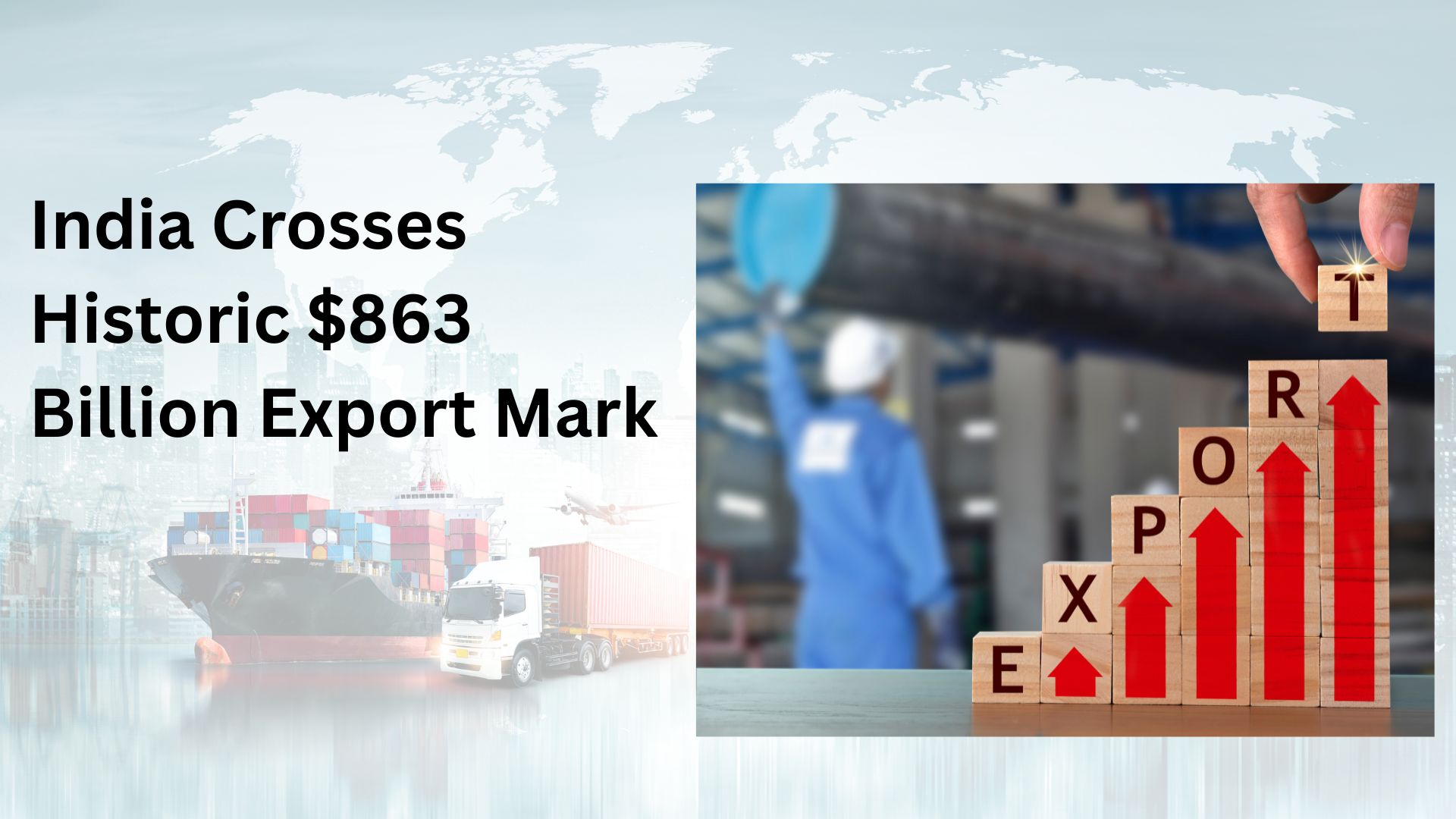
India’s exports touched an all-time high of $863.11 billion in FY26, highlighting the growing strength of the country’s services economy even as merchandise trade faced pressure from slowing global demand and geopolitical disruptions. Revised Commerce Ministry data showed that combined goods and services exports rose 4.6% year-on-year from $825.26 billion in FY25.
The biggest contributor to this growth was the services sector, which continued to outperform traditional goods exports. Services exports climbed 8.71% to $421.32 billion in FY26, compared to $387.55 billion in the previous fiscal year. The surge was driven by strong global demand for Indian IT services, business solutions, financial services, consulting and outsourcing capabilities.
In contrast, merchandise exports recorded a relatively modest increase of 0.93%, reaching $441.78 billion from $437.70 billion in FY25. While sectors such as engineering goods, electronics, pharmaceuticals, petroleum products and agricultural exports continued to support outbound shipments, global trade volatility and softer demand conditions limited sharper growth in goods exports.
Officials described the export performance as a sign of resilience amid a difficult global trade environment marked by geopolitical tensions, supply chain disruptions and commodity price fluctuations. According to Commerce Ministry officials, FY26 recorded the highest-ever export performance across all four quarters, underlining sustained momentum in India’s external trade sector.
The data also reflects a broader structural shift underway in India’s export economy. Services are increasingly becoming the stabilising force within the country’s trade basket. India’s services trade surplus stood at approximately $213.9 billion during the fiscal year, helping offset the widening merchandise trade deficit caused by faster import growth.
Imports, particularly in energy, electronics, machinery and precious metals, continued to rise during FY26 as domestic consumption and industrial activity remained strong. Merchandise imports climbed significantly, widening the overall trade deficit despite record export numbers. Analysts believe this reflects both India’s expanding economic activity and its continued dependence on imported industrial inputs and energy resources.
The strong performance of services exports comes at a time when global businesses are increasingly outsourcing technology, analytics, digital transformation and professional services work to India. The country’s deep talent pool, cost competitiveness and growing digital infrastructure continue to strengthen its position in global services trade.
Industry experts also point out that India’s export composition is gradually evolving beyond traditional sectors. Electronics manufacturing, engineering products, digital services and pharmaceuticals are playing a larger role in driving export growth, supported by government-led production-linked incentive (PLI) schemes, logistics improvements and trade diversification efforts.
Despite the positive milestone, economists caution that sustaining high export growth may remain challenging in the near term due to slowing global growth, geopolitical uncertainty and trade fragmentation across key international markets. However, India’s ability to maintain export expansion amid these conditions is being viewed as a sign of improving competitiveness and economic resilience.
The FY26 export figures also strengthen India’s long-term ambition of emerging as a larger player in global trade and supply chains. With services continuing to act as a growth engine, policymakers are expected to focus more aggressively on boosting manufacturing exports, improving trade infrastructure and expanding access to newer global markets in the coming years.