



The AI Boom Is Exposing a Fault Line in Electronics Manufacturing
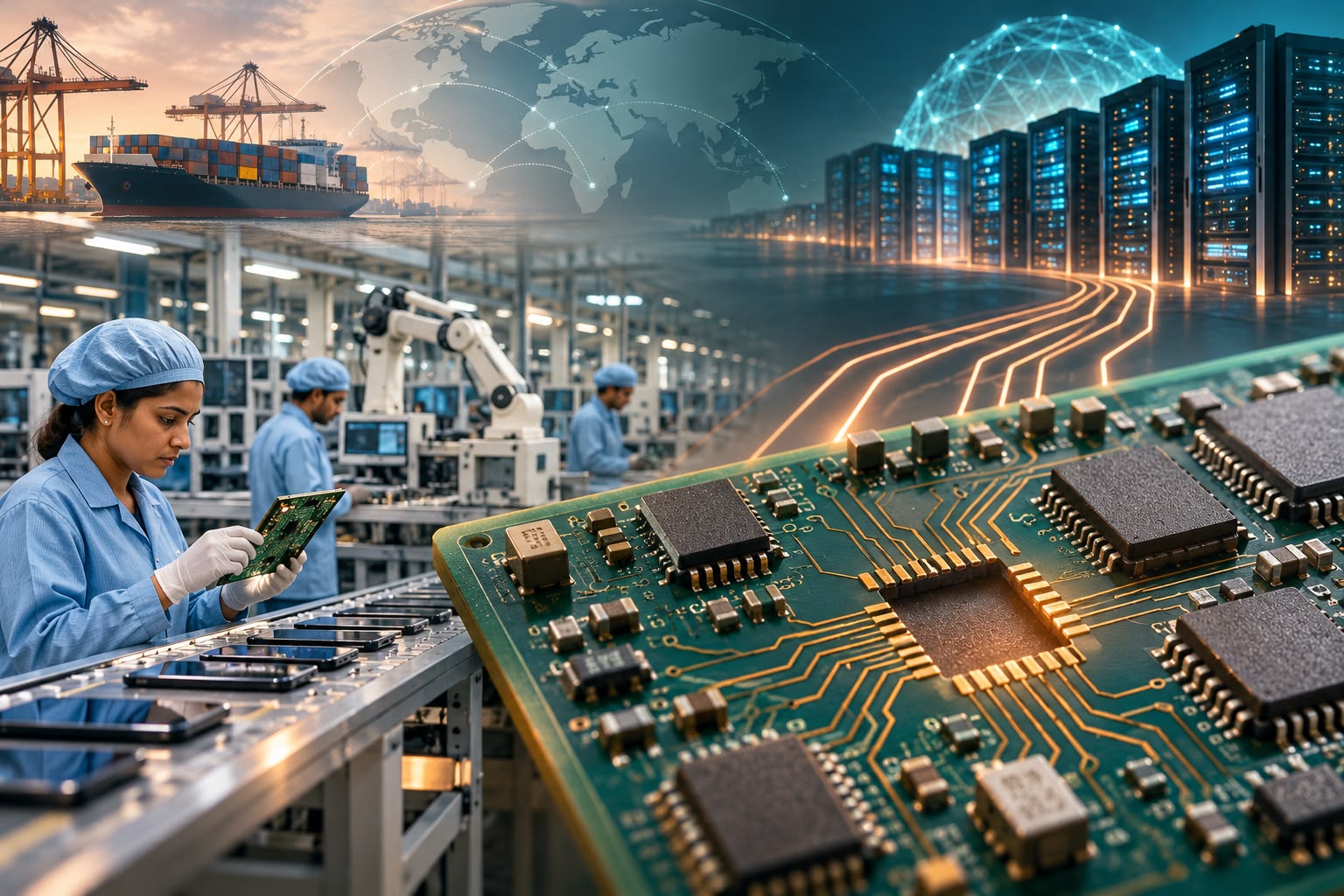
As AI-driven demand reshapes global component supply chains, the growing dependence on imported circuit boards raises a fundamental question about the depth and resilience of domestic electronics manufacturing.
India’s electronics manufacturing story has largely been told through expanding production lines, rising exports and the arrival of global technology companies. Yet the next test of its industrial competitiveness may be decided much further upstream, in the materials and components that rarely attract public attention.
Printed circuit boards (PCBs), the foundations on which electronic components are mounted and interconnected, have become an unexpected fault line in global manufacturing. The rapid expansion of artificial intelligence infrastructure is intensifying competition for sophisticated boards, specialist laminates and manufacturing capacity. For Indian electronics manufacturers, the consequences extend beyond procurement costs.
The deeper question is whether India is building an electronics industry or merely expanding its capacity to assemble electronics.
Growth without sufficient industrial depth
India’s progress is substantial. According to government figures, domestic electronics production reached ₹11.32 lakh crore in FY2024–25, compared with ₹1.9 lakh crore a decade earlier. Electronics exports rose to ₹3.26 lakh crore, establishing the sector among the country’s leading export categories.
But impressive output numbers conceal a structural imbalance.
Industry estimates published in 2025 indicated that India imported approximately 88 per cent of its bare PCB requirements during FY2024–25. This dependence exposes manufacturers to international price movements, currency fluctuations and supply disruptions that domestic production growth alone cannot resolve.
The distinction matters. Manufacturing electronic products is not synonymous with controlling the technologies, materials and supplier networks required to produce them.
When artificial intelligence changes industrial priorities
The global AI investment cycle is transforming demand across electronics supply chains. Advanced computing infrastructure requires increasingly complex multilayer boards, high-density interconnections and materials capable of maintaining electrical performance under demanding operating conditions.
Research firm Fortune Business Insights valued the global PCB market at $74.12 billion in 2025 and projects it could reach $126.93 billion by 2034. The growth opportunity is considerable, but capacity expansion is neither immediate nor evenly distributed.
Manufacturers serving high-value computing applications may command stronger pricing and preferential access to scarce inputs. Producers of industrial electronics, consumer devices and automotive systems consequently face greater procurement uncertainty.
This is not simply a shortage of boards. It is a redistribution of bargaining power within global manufacturing.
For smaller Indian enterprises, the implications are particularly significant. Larger manufacturers can negotiate long-term supply agreements, diversify sourcing and absorb temporary inventory costs. SMEs often operate with narrower margins, shorter order visibility and limited working capital.
An extended disruption can therefore become a competitive disadvantage even when customer demand remains healthy.
A warning from the factory floor
These vulnerabilities were among the broader competitiveness concerns discussed at Manufacturing Reimagined, the SME Communities conference organised with FIEO in Bengaluru in February 2026, focusing on electronics manufacturing and exports.
Discussions highlighted the importance of component localisation, working-capital discipline, stronger supply-chain integration and the transition from contract assembly towards design-led manufacturing.
The present PCB disruption reinforces the relevance of those concerns. A globally competitive electronics ecosystem cannot depend indefinitely on imported critical inputs while expecting domestic manufacturers to compete on cost, quality and delivery reliability.
The opportunity to manufacture differently
India is not starting from zero.
Companies such as Dixon Technologies, Kaynes Technology, Cyient DLM and Amber Enterprises illustrate the expanding capabilities of India’s electronics manufacturing ecosystem, spanning large-scale assembly, industrial electronics, integrated manufacturing services and component investments.
However, capabilities differ across companies, and electronics assembly capacity should not be confused with domestic production of bare PCBs or their constituent materials.
Government initiatives, including the Electronics Components Manufacturing Scheme, provide an opportunity to address these gaps. But financial incentives must be accompanied by investment in materials science, advanced fabrication, testing infrastructure, skilled personnel and supplier development.
For SMEs, shared industrial infrastructure and stronger relationships with larger manufacturers could prove particularly valuable.
From manufacturing scale to manufacturing resilience
The policy challenge is to distinguish between temporary supply pressures and enduring structural weaknesses.
Diversified sourcing, strategic inventory and better procurement forecasting can provide immediate protection. Longer-term competitiveness requires domestic technological capability, stronger balance sheets and integration into international supply networks.
India need not manufacture every electronic component domestically. But it must identify which dependencies are strategically consequential and develop credible alternatives.
The AI revolution may ultimately create enormous opportunities for Indian electronics manufacturers. Yet it is also exposing the difference between participating in a global supply chain and possessing influence within it.
India’s next electronics manufacturing milestone should therefore be measured not merely by how much it produces, but by how much of the underlying industrial capability it controls.