



The Next Competitive Divide: Will AI-Ready SMEs Pull Away from the Rest?
Artificial intelligence is beginning to reshape the economics of India’s smaller enterprises. The question is no longer simply whether SMEs can afford to adopt it, but whether they can afford the competitive consequences of standing still.
For decades, India’s small and medium enterprises have built their competitiveness on a familiar combination of entrepreneurial instinct, cost discipline, operational flexibility and relationships cultivated over generations.
Artificial intelligence could alter that equation.
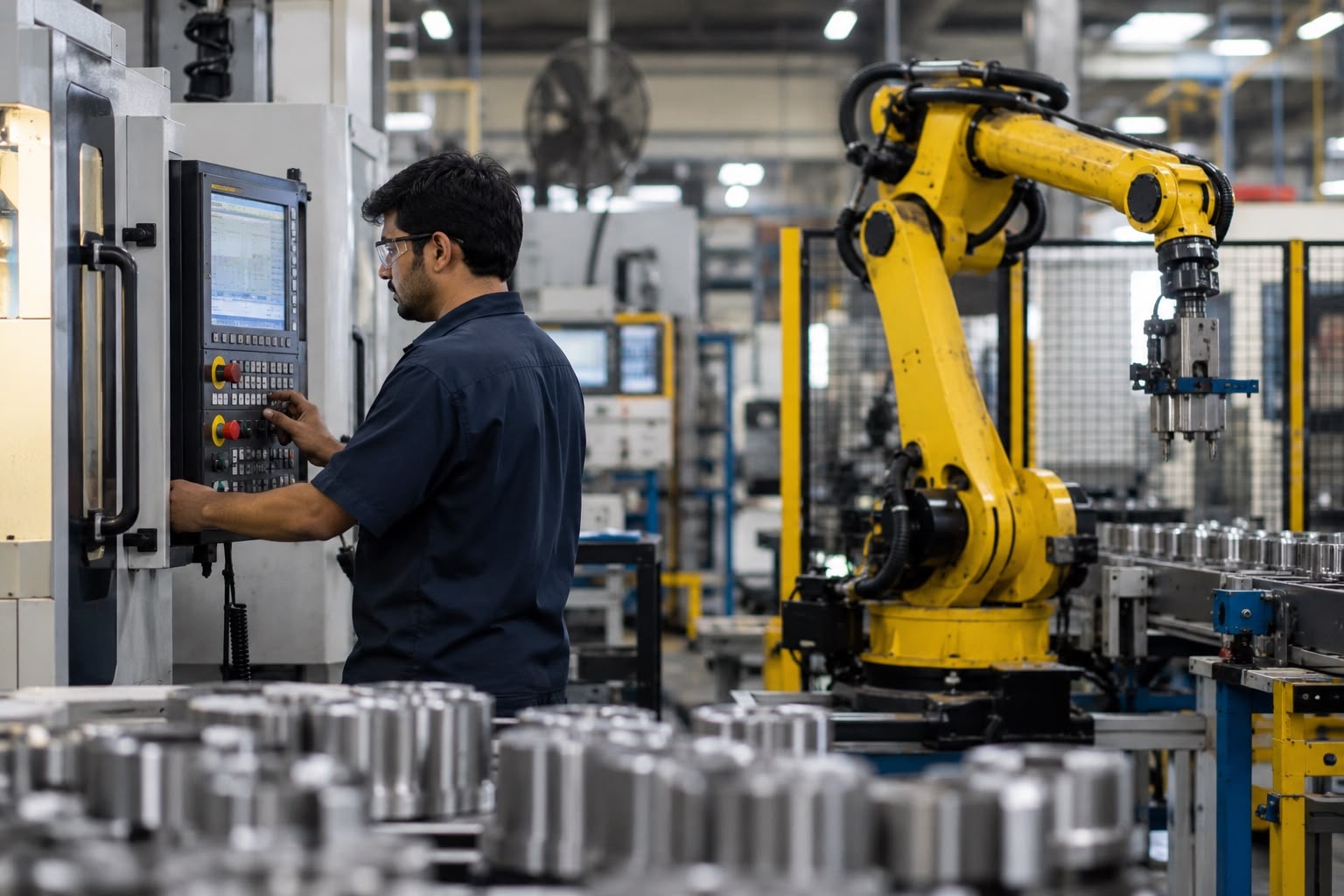
Across manufacturing clusters, export businesses and industrial supply chains, a new distinction is beginning to emerge: between enterprises that use technology primarily to record business activity and those increasingly using it to anticipate, optimise and influence outcomes. The implications extend well beyond automation. AI could change how smaller companies compete for customers, protect margins, deploy capital and participate in global value chains.
Experimentation to economic advantage
Consider Supertech Laminates, an Indian manufacturing enterprise that has been using AI-powered tools to refine its export strategy. According to reporting published by the Wadhwani Foundation in July 2025, the company has set an ambition of reaching $10mn in revenue by 2028, supported by improved data utilisation and AI-driven business insights.
The revenue figure is a target rather than an achieved outcome. Nevertheless, the example illustrates a significant shift in how smaller businesses are approaching technology: not merely as an administrative efficiency tool, but as an instrument of commercial expansion.
A different application is emerging on the factory floor.
A World Economic Forum and Boston Consulting Group study documents an Indian steel-manufacturing MSME that deployed AI-enabled visual inspection to identify production defects. The system reportedly improved first-pass quality rates by 30 per cent, reducing the need for rework. For a manufacturer operating on narrow margins, such improvements can have consequences for profitability, production capacity and customer confidence.
The significance lies in the cumulative effect. Better inspection reduces waste. Lower waste improves margins. More consistent quality strengthens relationships with buyers. Over time, these advantages can become difficult for competitors to replicate through price reductions alone.
The factory is becoming a source of intelligence
India’s emerging industrial technology companies offer further evidence of how this transformation could unfold.Rapidise, an Indian electronics design and manufacturing business, has integrated AI-based quality inspection and internally developed automation into its production operations. In a September 2026 interview with Express Computer, founder Brijesh Kamani described building testing equipment internally at a fraction of the cost of commercially available alternatives. The company also uses AI-enabled cameras to inspect components and assemblies.
The larger implication is that competitive advantage may increasingly depend on a manufacturer’s ability to combine engineering expertise with proprietary operational intelligence. Yet this transition need not require the financial resources of a large corporation.
Smaller manufacturers can begin with narrowly defined applications: identifying recurring defects, predicting machine failures, improving inventory visibility or analysing production bottlenecks.
What matters is whether the investment produces measurable operational returns.
A potential $500bn opportunity
The scale of the opportunity is substantial.
A World Economic Forum playbook, developed with Boston Consulting Group and published in October 2025, estimates that AI could unlock more than $500bn in economic value for India’s MSME sector. That is a projection, not a forecast of realised gains. Its significance lies in the breadth of potential applications across enterprises that collectively contribute close to 30 per cent of India’s GDP.
But adoption remains uneven.
Smaller businesses frequently lack structured operational data, specialised technology teams and the financial capacity to experiment with systems whose returns are uncertain. Even where solutions are affordable, implementation requires changes in processes, management practices and employee capabilities.
These constraints could create an uncomfortable paradox: the enterprises with the greatest potential productivity gains may also face the highest barriers to adoption.
The emerging divide
For India’s export-oriented SMEs, the consequences could be particularly significant. International buyers increasingly expect consistency, traceability, delivery reliability and responsiveness. AI-enabled systems could help suppliers meet these expectations while controlling costs.
The competitive comparison may therefore shift from labour costs and production capacity towards a broader assessment of technological capability. A supplier able to predict delays, identify defects early and optimise resource consumption could become more attractive than one relying predominantly on manual supervision and retrospective reporting.
There is also a financing dimension.
Better operational data could eventually help lenders and investors assess enterprise performance with greater precision. Whether AI readiness itself becomes a meaningful factor in credit assessment remains uncertain, but the underlying quality of business information is likely to matter increasingly.
None of this guarantees that early adopters will succeed. Poorly implemented AI can introduce costs, cybersecurity vulnerabilities and dependence on technology vendors without delivering commensurate benefits.
Nor should technological sophistication be confused with commercial strength. Customer relationships, engineering competence and managerial judgement remain essential.
A question of leadership
The next phase of AI adoption among Indian SMEs is unlikely to be determined by the number of software subscriptions purchased or pilot projects announced. It will be determined by whether promoters and management teams can identify business problems where intelligent systems demonstrably improve outcomes.
For some, that may mean reducing rejection rates. For others, shortening working-capital cycles, improving export-market intelligence or managing increasingly complex supply chains.
The most successful enterprises may not be those investing most heavily in AI, but those applying it most selectively and consistently. India’s SME sector has repeatedly demonstrated its ability to adapt to changing markets, technologies and economic conditions.
The emerging challenge is different. AI has the potential to make productivity improvements cumulative, allowing technologically capable businesses to extend their advantages over time. The next competitive divide in Indian industry may therefore emerge not between large enterprises and small ones, but between SMEs that learn to operate with intelligence embedded in their businesses and those that continue to depend almost entirely on experience and intuition.
For India’s SME promoters, the strategic question is becoming increasingly consequential: will AI be another technology they adopt, or a capability around which they rebuild their competitive advantage?