



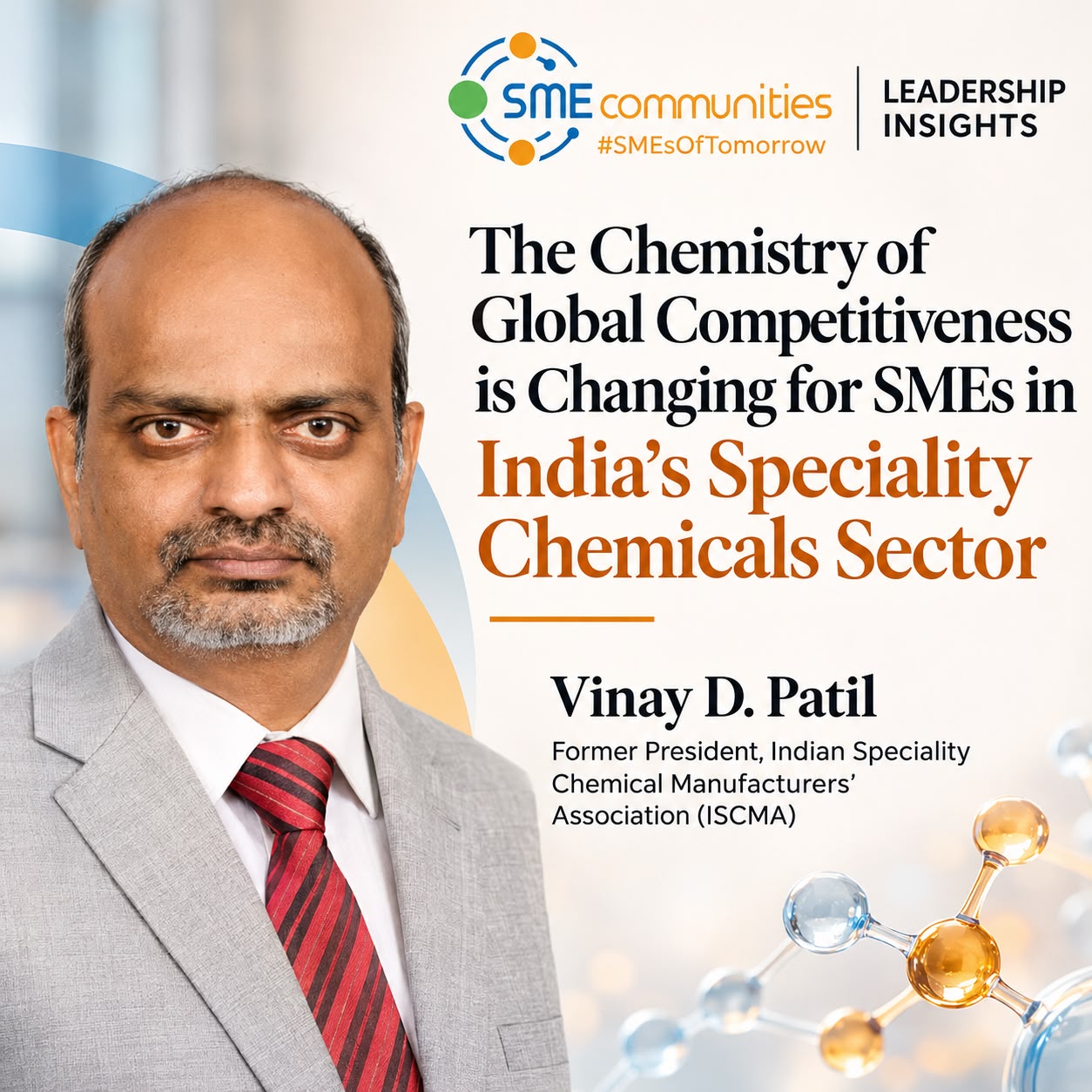
The Chemistry of Global Competitiveness is Changing for SMEs in India’s Speciality Chemicals Sector
As global industries demand increasingly sophisticated materials and formulations, India’s speciality chemical manufacturers have an opportunity to become strategic partners in international value chains.
By Vinay D. Patil
Former President, Indian Speciality Chemical Manufacturers’ Association (ISCMA)
India’s speciality chemicals industry stands at an important inflection point. Its next phase of growth may depend less on expanding manufacturing capacity and more on developing the technical capabilities that make Indian companies indispensable to industries across the world.
The distinction is fundamental. While commodity chemicals compete predominantly on price and scale, speciality chemicals derive their value from performance, innovation and application-specific solutions.
According to NITI Aayog’s 2025 report on India’s chemical industry, domestic consumption of speciality chemicals is estimated at $40–45 billion. The segment accounts for more than half of India’s chemical exports, underlining its strategic importance within the country’s manufacturing economy.
Yet the opportunity ahead extends considerably beyond traditional chemical markets.
The industries driving the next wave
Speciality chemicals are increasingly central to technological advancement across multiple industries.
In electronics and semiconductors, high-purity chemicals, specialised coatings, cleaning agents and advanced formulations are essential to manufacturing precision and reliability. India’s expanding electronics ecosystem could create opportunities for domestic producers capable of meeting stringent technical specifications.
Electric mobility and energy storage present another frontier. Battery electrolytes, conductive additives, flame retardants and thermal-management materials influence performance, safety and durability.
Construction and infrastructure require advanced waterproofing compounds, concrete admixtures, protective coatings and adhesives that improve asset longevity and reduce maintenance costs.
Pharmaceuticals, food processing and personal care depend on specialised ingredients, functional additives, processing aids and high-purity intermediates. Meanwhile, textile processing, water treatment and industrial manufacturing increasingly require chemicals that improve resource efficiency and environmental performance.
These applications reveal a significant opportunity: speciality chemicals are no longer merely industrial inputs. They are increasingly enablers of productivity, sustainability and technological differentiation.
India’s opportunity in global supply chains
International manufacturers are reassessing sourcing strategies, seeking greater diversification, supply reliability and technical collaboration.
India enters this transition with an established manufacturing base. Government data released in November 2026 identify approximately 4.45 lakh MSMEs across the broader chemicals and petrochemicals sector. However, participation in global value chains requires more than competitive pricing.
Customers increasingly expect consistent quality, regulatory documentation, product traceability and the ability to develop formulations suited to specific applications.
For Indian SMEs, this creates opportunities in custom synthesis, performance additives, specialised intermediates and collaborative product development. The greatest potential may lie in moving from transactional supply relationships towards long-term technical partnerships with international customers.
Innovation must become a competitive advantage
India’s chemical industry also faces structural challenges. NITI Aayog estimates that the broader chemicals sector recorded a trade deficit of approximately $31 billion in 2023, reflecting dependence on imported feedstocks and certain advanced chemicals.
Smaller manufacturers face additional constraints, including limited research budgets, expensive testing infrastructure, environmental compliance requirements and lengthy customer qualification cycles. Addressing these barriers will require stronger industry-academia collaboration, shared research and testing facilities, specialised skills and greater investment in application development.
Sustainability deserves particular attention. Resource-efficient manufacturing, wastewater recovery, cleaner processing technologies and circular material solutions can create commercial differentiation while supporting environmental objectives. For SMEs, innovation need not always mean developing entirely new molecules. Improving formulations, manufacturing processes and application performance can be equally valuable.
From manufacturing strength to global relevance
India’s speciality chemicals industry possesses an opportunity to establish a stronger position in international markets. But scale alone will not determine success. The manufacturers most likely to prosper will be those that understand their customers’ industries, anticipate technological changes and invest consistently in quality, innovation and sustainability.
India’s speciality chemicals industry cannot achieve global competitiveness through individual efforts alone. ISCMA has a critical role in aligning industry priorities, facilitating technical collaboration, strengthening regulatory preparedness and advocating policies that enable SME growth. Manufacturers, in turn, must invest in innovation, improve quality standards and build partnerships that position India as a trusted global supplier.
For India’s speciality chemical SMEs, the next competitive frontier is not simply producing more chemicals.
It is becoming the partner that global industries turn to when they need better solutions.