




The New Age of SME Banking: Where Capital Meets Capability
India’s MSME sector stands at a defining moment in its evolution.
The forces reshaping global commerce, supply-chain diversification, digital transformation, geopolitical realignments and the rapid adoption of artificial intelligence are simultaneously creating unprecedented opportunities and new competitive pressures for Indian enterprises. As businesses prepare to play a larger role in global value chains, access to finance, while essential, is no longer sufficient.
Today’s entrepreneurs seek strategic partners capable of providing market intelligence, technology-enabled banking, trade facilitation, advisory support and long-term institutional confidence alongside capital. This changing landscape is fundamentally redefining the relationship between banks and businesses.
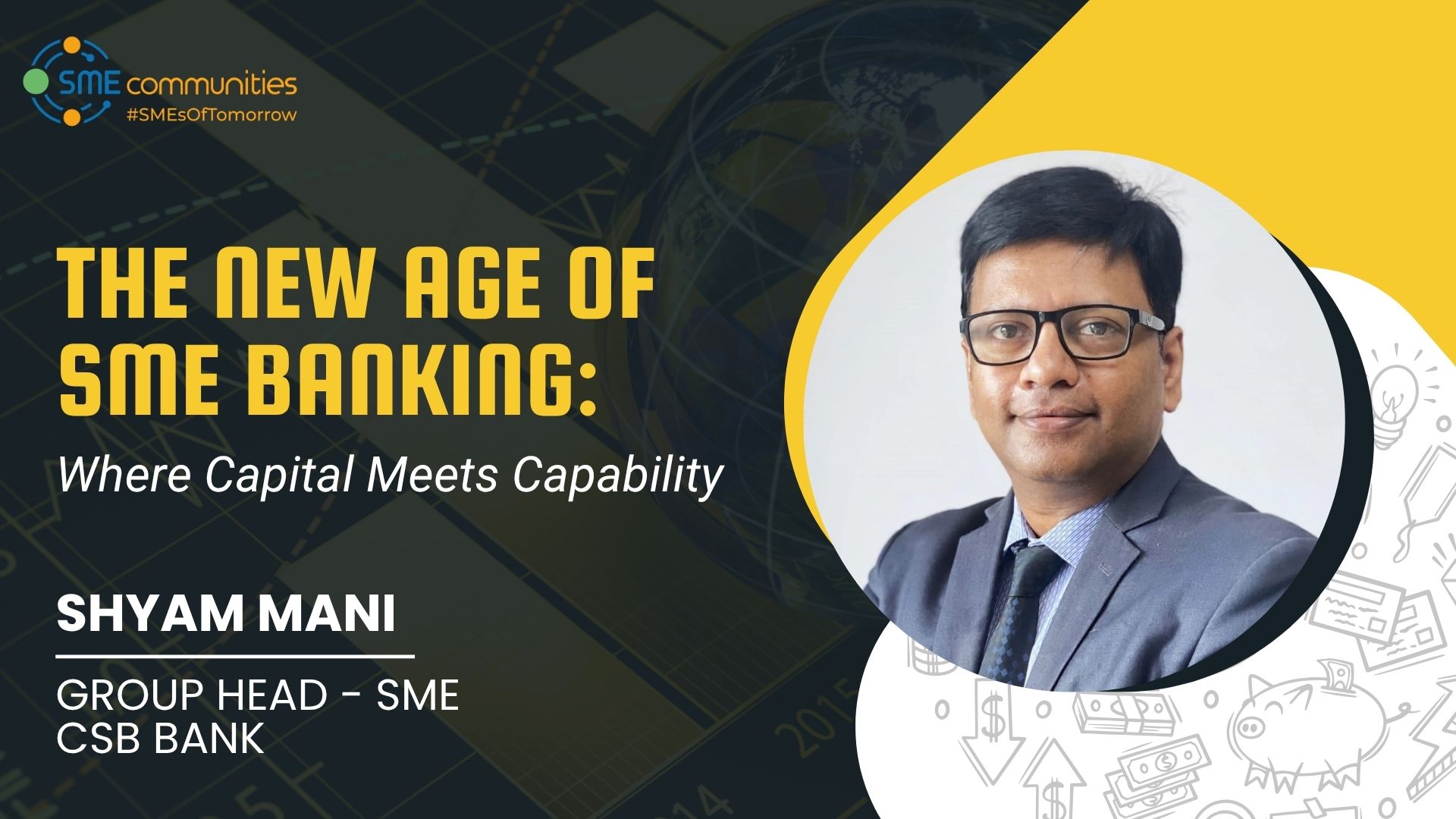
In this special conversation with SME Communities, Shyam Mani, Group Head – SME, CSB Bank, shares his perspective on how SME banking is evolving from a product-led business into an ecosystem-led partnership, why technology must complement not replace human relationships and what India’s entrepreneurs must do to build globally competitive enterprises in the journey towards Viksit Bharat 2047.
Indian MSMEs today are navigating an environment shaped by economic uncertainty, digital disruption and shifting global supply chains. From a banking perspective, do you believe we are witnessing the emergence of a fundamentally different generation of entrepreneurs compared with a decade ago?
Absolutely.
Today’s entrepreneur is far more informed, ambitious and digitally aware than ever before.
Many MSMEs now aspire to build national and even global businesses rather than remaining confined to regional markets.
Consequently, their expectations from banks have evolved. They seek speed, transparency, advisory support and technology-enabled banking rather than simply access to credit.
Banks therefore need to become long-term growth partners rather than transaction providers.
Access to finance has traditionally been considered the biggest challenge for MSMEs. Increasingly, however, entrepreneurs are seeking knowledge, market access and strategic partnerships alongside capital. How is SME banking evolving to meet these changing expectations?
Credit remains a critical lever for managing risk, cash flow and economic growth. However, sustainable business growth requires much more than funding. Modern SME banking must integrate lending with transaction banking, trade finance, digital payments, receivable financing and advisory capabilities. The future of SME banking will be defined by a shift from traditional lending models to data-driven, ecosystem-based financial services.
At CSB Bank, we support the evolving needs of MSMEs through financial solutions designed to drive growth and resilience. Our offerings span working capital finance, tailored lending products, and sector-specific advisory, delivered through a relationship-led and execution-focused approach. By combining deep market insight with responsive service, we enable MSMEs to scale sustainably and play a vital role in India’s economic growth.
CSB Bank has steadily expanded its SME franchise across several manufacturing and business clusters in India. What have been your biggest learnings from engaging with entrepreneurs across diverse industries and regions?
Every geography has its own industrial strengths. Whether it is engineering, textiles, chemicals, food processing or services, entrepreneurs share a common aspiration: to build sustainable businesses for future generations.
One consistent learning has been that successful businesses are proactive. They invest early in governance, financial discipline, technology adoption and customer relationships.
Banks appreciate businesses that demonstrate preparedness because it enables faster decision-making and stronger long-term partnerships.
As India’s manufacturing ambitions gather momentum through initiatives such as ‘Make in India’ and increasing global supply-chain diversification, what role do you see banks playing in helping MSMEs become globally competitive rather than simply financially supported?
Banks have an important responsibility beyond extending credit. We enable businesses through trade finance, working capital optimisation, receivables financing, digital banking and international banking solutions.
As Indian MSMEs integrate into global supply chains, the ability to provide timely, flexible and technology-enabled financial solutions becomes increasingly important.
The future belongs to banks that understand businesses rather than merely evaluating balance sheets.
Digitalisation, AI and data-driven credit assessment are transforming banking itself. Looking ahead, how do you see technology changing the relationship between banks and MSMEs over the next five years?
There is a fundamental shift happening in the MSME lending framework. As against traditional models, Banks are having a comprehensive lens at entire eco-system of borrowers through available data and information to get better understanding of the business before making lending decision.
The MSME lending ecosystem is undergoing a structural shift from a fragmented, document-driven model to a more integrated, data- and ecosystem-led framework. This transition is being powered by digital infrastructure, collaborative partnerships and progressive regulation each playing a critical role in redefining credit delivery.
At the same time, the human element will remain critical. Technology can improve efficiency, but trust continues to build relationships.
The future of SME banking lies in combining digital capabilities with personalised advisory support.
India has set itself the ambitious objective of becoming a developed economy by 2047. What message would you like to share with entrepreneurs about the role they will play in building Viksit Bharat?
India’s development story will ultimately be written by its entrepreneurs. MSMEs contribute significantly to the economy and social development of the country by fostering entrepreneurship and generating large employment opportunities. There are 7.61 cr of MSMEs registered on Udyam /Udyam Assist portal and the number is growing. Their contribution towards India’s GDP (~31% share), manufacturing output (~35% share) and exports (~48.5% share) are significant and it would only grow from here.
The coming decades present an unprecedented opportunity for Indian businesses to become part of global value chains.
My message to entrepreneurs is simple: Continue investing in innovation, governance, technology and people. Banks, industry and policymakers are all working towards creating an ecosystem that supports this journey. Together, we can build globally competitive enterprises that contribute meaningfully to India’s vision of becoming a developed economy by 2047.
The SME Communities Perspective
The conversation with Shyam Mani reflects a broader transformation taking place within India’s financial ecosystem. The future of SME banking will not be determined solely by the ability to extend credit, but by the capacity to build enduring partnerships that help businesses innovate, compete and expand globally.
As India’s ambition of becoming a developed economy gathers momentum, the relationship between banks and entrepreneurs is evolving from lender and borrower to long-term growth partners. Institutions that combine technology with trusted advisory, sectoral understanding and execution excellence will be best positioned to power the country’s next generation of enterprise.
For India’s millions of MSMEs, the message is equally compelling. Sustainable competitiveness will increasingly depend on governance, digital capability, financial discipline and continuous innovation. Businesses that embrace these fundamentals today will not merely participate in India’s growth story; they will help write it.