



THE ECONOMICS OF PROTECTION
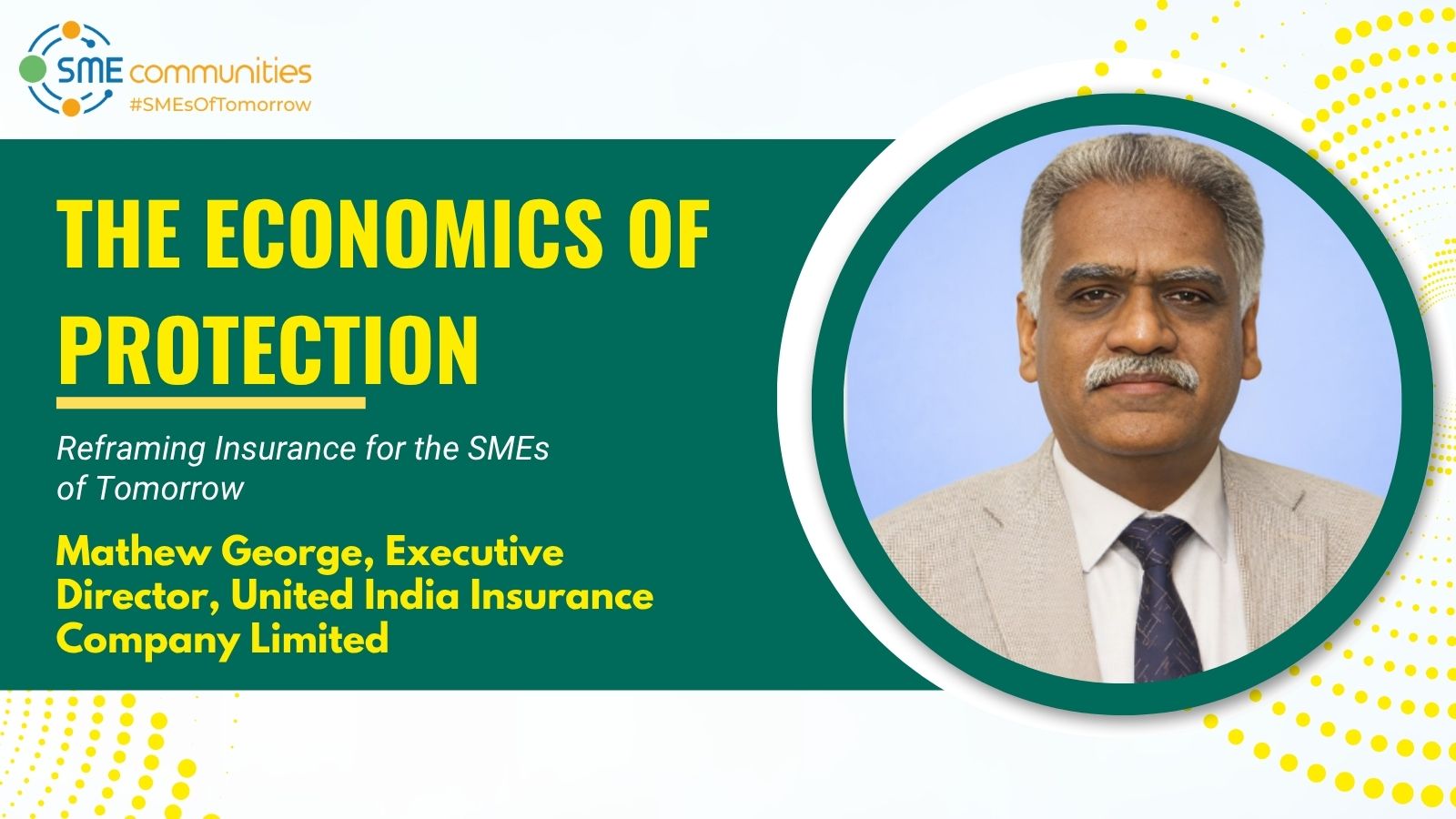
Mr. Mathew George, Executive Director, United India Insurance Company Limited, on Reframing Insurance for the SMEs of Tomorrow
India’s SMEs are changing faster than the traditional boundaries of risk and insurance around them. As businesses become more automated, digitally connected and globally ambitious, the question of protection is moving beyond policies and premiums to something more fundamental: enterprise resilience.
Few insurance leaders have observed this evolution over as long a period as Mathew George, Executive Director, United India Insurance Company Limited. Drawing on decades of engagement with businesses and entrepreneurs, he reflects on how the SME-insurer relationship has evolved, why risk must increasingly be viewed through the lens of business continuity, and what the SMEs of tomorrow should expect from the insurance industry.
In conversation with Prashant Laxmeshwar, Founder, SME Communities.
SMEs have been part of your professional landscape across different stages of your career. What do you remember most about your early interactions with entrepreneurs and smaller businesses and what did those encounters teach you about the way SME promoters think about their enterprises?
One of the enduring characteristics of the SME entrepreneur is the deeply personal relationship he or she has with the enterprise. In a large corporation, ownership, management and operating risk are distributed across institutions and individuals. In a small or medium enterprise, they are often concentrated in one person or one family. The factory, the employees, the receivables, the borrowing and frequently even the family’s financial security are interconnected.
That changes the way an entrepreneur looks at risk. Particularly in the earlier years of my career, insurance was often viewed primarily as something required by a bank, a contract or a regulation. The entrepreneur’s attention was understandably focused on production, customers, working capital and growth. Protection tended to enter the conversation later.
But an SME can actually be more vulnerable to a major loss precisely because it has fewer buffers. A damaged machine, a fire, an interrupted supply chain or a large liability can affect not merely one line in a balance sheet but the continuity of the enterprise itself.
That has stayed with me throughout my career. The relevant question is not simply, “What assets have you insured?” It is, “What could prevent this business from operating tomorrow?” Once the conversation begins there, insurance acquires a very different meaning.
You have had the unusual opportunity to observe Indian SMEs over several decades. What changes have impressed you most in the ambition, sophistication and outlook of today’s SME entrepreneur compared with the businesses you encountered earlier in your career?
The change has been remarkable. The earlier SME was often built around a strong entrepreneurial instinct, technical competence and an ability to operate efficiently within a relatively defined market. Those qualities remain. But today’s entrepreneur is operating with a much wider horizon.
A medium-sized manufacturer today may be installing sophisticated machinery, supplying a multinational company, importing components, exporting finished products, adopting ERP and cloud platforms, financing expansion institutionally and competing against companies from several countries. Many are thinking about energy efficiency, automation, quality certification, data, sustainability and professional governance much earlier in their development.
What has changed, therefore, is not merely the size of the SME. It is the complexity of the enterprise.
And risk tends to grow in complexity faster than it grows in visibility. A company can modernise its plant and simultaneously become dependent on a smaller number of technologically critical machines. It can digitise its operations and create cyber exposure. It can globalise its customers and create new contractual or transit risks.
The encouraging development is that many entrepreneurs are beginning to recognise this. They increasingly expect professional advice from their bankers, insurers and other financial partners rather than simply products.
The SME of today wants to participate in the same opportunity set as a large company. The financial ecosystem surrounding it must therefore become capable of providing a comparable quality of risk thinking appropriately scaled to the enterprise.
As enterprises grow, their relationship with insurance also tends to evolve. From your experience, how can an insurer move beyond being a provider of policies to becoming a meaningful partner in an SME’s growth journey?
The first change required is philosophical. Insurance should not begin with a policy. It should begin with an understanding of the business.
What does the enterprise manufacture? Which asset is critical to production? How concentrated is the supply chain? What would happen if the factory were unavailable for three months? How dependent is the company on one customer, one location, one machine, one technology platform or one overseas market?
These questions take the insurer much closer to the economics of the enterprise.
The second requirement is continuity. Protection cannot be treated as an annual transaction that begins thirty days before renewal and ends when the premium is paid. A growing SME is a moving target. It acquires machinery, adds warehouses, takes on employees, enters new contracts, exports to new markets and becomes increasingly technology-dependent. Its risk architecture changes continuously.
The third is service at the moment when insurance actually matters the claim. Customers ultimately form their judgement of insurance not when the policy is issued but when an unexpected event occurs. Clarity of coverage, responsiveness, documentation and efficient claims servicing are therefore central to trust.
Finally, insurers have an important role in risk prevention. If years of claims data and underwriting experience allow us to identify recurring vulnerabilities, that knowledge should help customers reduce the probability and severity of loss.
That, to me, is the evolution from insurer to risk partner: understand the enterprise, protect the critical exposures, help reduce the risk and respond effectively when a loss occurs.
Manufacturing SMEs today are investing in automation, connected equipment, digital platforms and increasingly sophisticated supply chains. How does this transformation change the way entrepreneurs should think about protecting their businesses?
A modern factory has increasingly become both a physical system and a digital system. That distinction is very important.
Traditionally, the principal exposures were relatively visible buildings, machinery, stocks, fire, transit, employee accidents and so on. Those risks remain, but they are becoming interconnected with less visible dependencies.
A highly automated machine may dramatically improve productivity, but its failure can interrupt an entire production process. Connected equipment can improve efficiency but create cyber vulnerability. Just-in-time inventory can reduce working capital but increase dependency on suppliers and logistics. A sophisticated ERP platform can create transparency across the enterprise, but a technology outage can affect several functions simultaneously.
The consequence is that entrepreneurs should gradually move from asset-based insurance thinking to continuity-based risk thinking.
It is no longer sufficient to ask whether the factory and machinery are insured. One must ask how quickly that machinery can be replaced, what happens to revenue while production is interrupted, whether critical electronic equipment is adequately protected, whether cyber incidents have been considered, what contractual liabilities exist and where supply-chain dependencies lie.
Products such as property, machinery breakdown, electronic equipment, business interruption, marine, liability and cyber covers should therefore not be viewed as unrelated policies. They are components of an enterprise protection architecture.
Technology has made SMEs more productive. The task now is to ensure that it also makes them more resilient.
Indian SMEs are also becoming increasingly export-oriented and globally connected. What new considerations arise when an enterprise moves beyond its traditional domestic market and begins dealing with customers, suppliers and operations across borders?
Globalisation expands opportunity, but it also expands the perimeter of risk.
The moment an enterprise begins sourcing or selling internationally, events thousands of kilometres away can affect its balance sheet. Cargo may travel through several modes and jurisdictions. A supplier disruption can halt production. Contractual obligations may become more demanding. Currency movements, geopolitical events, changes in trade routes and differing legal environments can all have consequences.
The SME entrepreneur should therefore look beyond the traditional idea of simply insuring a shipment. For an exporter, the first layer is obviously the physical movement of goods appropriate marine cargo protection across domestic transit, exports and imports. But beyond transit there may be questions of product liability, contractual liability, overseas travel, project exposures, business interruption and increasingly cyber and data risks.
There is another important dimension: risk concentration. An SME entering exports can sometimes become disproportionately dependent on one geography, customer, shipping route or overseas supplier. Insurance cannot eliminate every commercial risk, but identifying these concentrations is part of building resilience.
Global customers also increasingly expect their suppliers to demonstrate professional risk-management standards. Good insurance and good risk management can therefore contribute not only to protection but also to credibility.
For the SME of tomorrow, global competitiveness and risk preparedness will increasingly have to develop together.
Technology is changing insurance itself from data and analytics to AI, digital servicing and more sophisticated assessment of exposures. What could these developments mean for the quality and relevance of protection available to SMEs over the coming decade?
The real promise of technology in insurance is not simply that a policy can be issued faster. It is that insurance can become more informed, more relevant and more responsive.
SMEs are extraordinarily heterogeneous. Two enterprises with similar turnover may have completely different risk characteristics because of their machinery, processes, location, customers, safety systems or supply chains. Historically, the economics of serving smaller businesses sometimes encouraged standardisation.
Data and analytics give insurers the opportunity to become more granular. Better information can improve risk selection and pricing. Digital interfaces can simplify servicing. AI can assist in analysing documents and identifying patterns. Technology can accelerate portions of claims processing, while connected systems can potentially improve risk monitoring and prevention.
Over time, this could move insurance away from periodically looking at a business towards understanding aspects of its risk much more dynamically.
But we must retain perspective. Insurance is ultimately a promise involving judgement and trust. Technology should strengthen those qualities, not remove them.
There will always be situations particularly complex commercial losses where human expertise, context and judgement remain indispensable. The winning model will therefore not be technology replacing insurance professionals. It will be technology enabling insurance professionals to make better decisions and serve customers more effectively.
For SMEs, that should ultimately translate into protection that is easier to access, better matched to actual exposures and more responsive when required.
Your association with the MSME ecosystem has continued into your senior leadership years, including UIIC’s collaboration with SIDBI. What have such engagements taught you about what growing enterprises increasingly expect from their insurers?
The collaboration with institutions such as SIDBI reinforces an important principle: access to finance and protection from risk are complementary parts of enterprise development.
An entrepreneur may obtain capital to purchase machinery or expand a factory. But the economic value created by that investment must then be protected against events capable of impairing the business.
What growing enterprises increasingly expect is relevance and simplicity.
An SME promoter does not necessarily want to become an expert in insurance terminology. He or she wants someone to understand the enterprise, identify meaningful exposures, explain them clearly and construct suitable protection.
That is why customisation becomes important. MSMEs span manufacturing, services, exports, logistics, healthcare, technology and numerous other sectors. Their requirements cannot be reduced to a single product.
At United India, the ecosystem available to enterprises can extend across property protection such as the Bharat Sookshma and Laghu Udyam frameworks, engineering, marine, liability, motor, health and other commercial covers. But the greater objective is not to sell the maximum number of policies. It is to minimise the significant gaps between the risks an enterprise carries and the risks it has consciously protected.
Partnerships with institutions that already understand SMEs can be powerful because they bring finance, risk awareness and protection closer together.
The future of SME insurance penetration will depend as much on distribution, education and trust as it does on product innovation.
If we look towards 2035, the Indian SME could be larger, more automated, more digital and considerably more global. How do you envisage the relationship between such an enterprise and its insurer evolving?
By 2035, I would hope the relationship is considerably less transactional than it is today.
The distinction between an SME’s operating strategy and its risk strategy will progressively narrow. As companies become more automated, interconnected and global, resilience will increasingly influence competitiveness itself.
The insurer of that period should therefore know substantially more about the customer’s risk environment. With appropriate consent and safeguards, data may allow assessment to become more continuous. Insurance programmes may become more modular. Some risks may be priced more dynamically. Parametric structures could become relevant in areas where clearly measurable triggers can complement traditional indemnity insurance.
More importantly, the conversation may shift from “How much insurance should I purchase?” to “How resilient is my enterprise?”
That is a much more sophisticated question. The insurer could increasingly become part of a wider ecosystem that includes lenders, technology providers, risk engineers, logistics partners and specialist advisers. The objective would be to reduce vulnerabilities before a loss occurs and provide financial protection for the residual risk that remains.
There is also an opportunity for the industry to make sophisticated protection accessible to smaller enterprises. Historically, the best risk-management resources were often concentrated around large corporations. Technology should help democratise that capability.
If India is to produce a generation of globally competitive SMEs, the insurance industry should aspire to provide them with globally credible resilience as well.
Having observed Indian SMEs across different stages of your own career, what would you say to the next generation of entrepreneurs who are today building the SMEs of Tomorrow?
I would first say: retain the ambition. The opportunity available to Indian entrepreneurs today is significantly larger than it was for previous generations. Technology has reduced barriers. Global supply chains are changing. Manufacturing is becoming strategically important again. Indian enterprises have the opportunity to serve markets far beyond their immediate geography.
But ambition should be accompanied by resilience.
Entrepreneurs naturally spend enormous amounts of time asking how to grow how to acquire the next customer, finance the next machine, enter the next market or improve productivity. I would encourage them to periodically ask another question:
What have I built that I cannot afford to lose? It may be a factory. It may be a critical machine. It may be data, people, reputation, intellectual property, a supply relationship or the ability to continue operating after a major disruption.
Once those dependencies are understood, risk management becomes a strategic exercise rather than an insurance exercise.
Insurance cannot prevent every setback, and it should never create complacency. Good enterprises invest first in safety, governance, maintenance, cybersecurity and disciplined processes. Insurance then protects the financial consequences of risks that cannot be completely eliminated.
Over the years I have seen businesses recover from serious events and I have seen how difficult recovery can become when protection is inadequate. That experience leaves me with a simple belief:
Growth creates value. Resilience preserves it. The SMEs of Tomorrow will need both.