



THE REWIRING OF VATVA
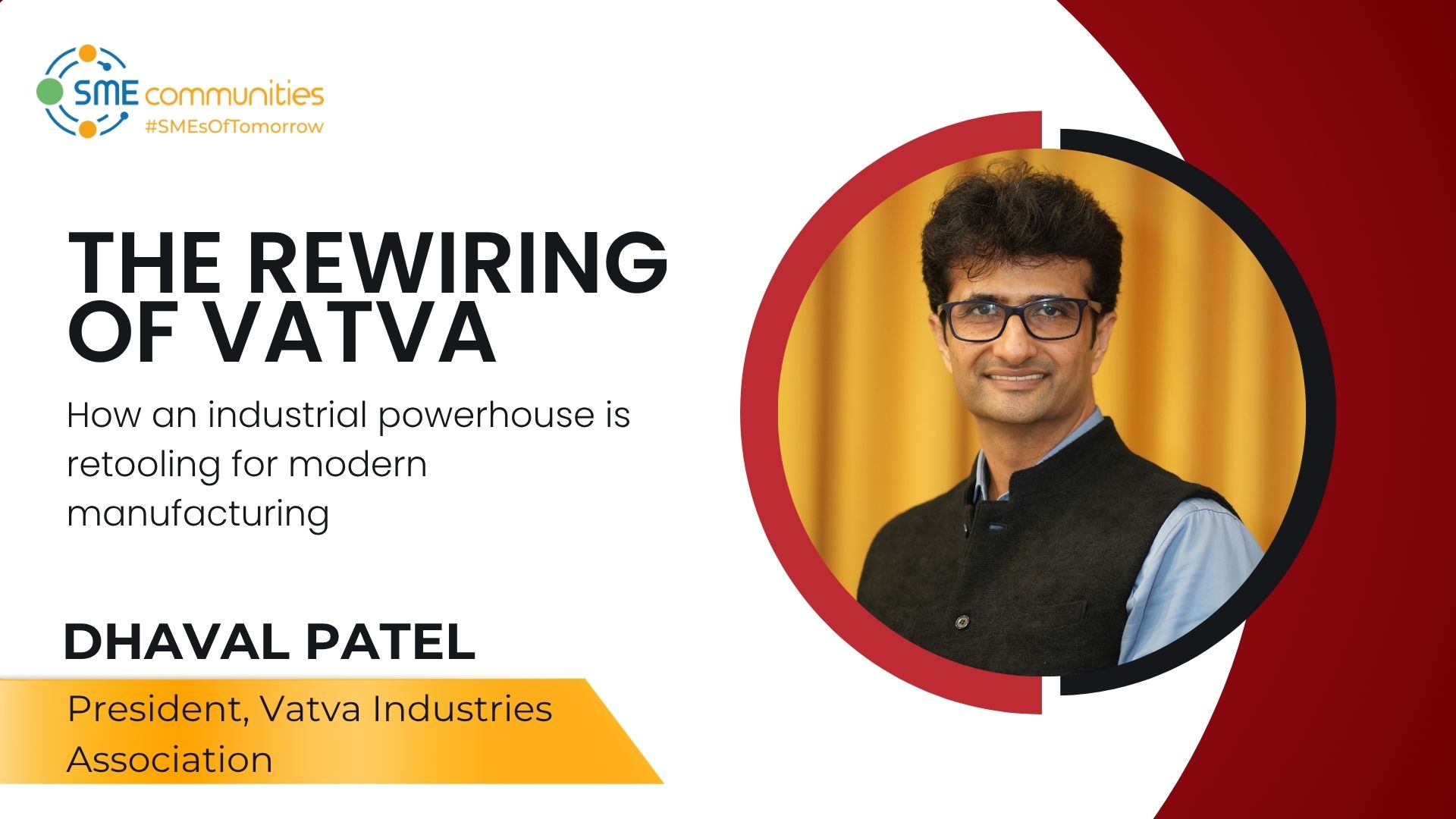
How an industrial powerhouse is retooling for modern manufacturing
For more than half a century, Vatva has been part of the industrial architecture that made Gujarat a manufacturing powerhouse. But longevity is no guarantee of future competitiveness.
The next test for one of the state’s most established manufacturing clusters is not simply to produce more, but to produce differently – with greater automation, cleaner processes, stronger skills, tighter quality systems and the ability to compete in increasingly demanding supply chains.
For Dhaval Patel, President of the Vatva Industries Association, this transition is as much about pragmatism as technology. Modernisation, he argues, need not begin with grand investments or fashionable terminology. For an MSME, its value is ultimately measured on the shop floor: less waste, higher productivity, better quality and stronger competitiveness.
In this conversation with SME Communities, Dhaval Patel discusses how Vatva can turn decades of accumulated manufacturing experience into an advantage for the next industrial cycle – and why the Factory of the Future may be built as much through people, collective action and practical investment decisions as through machines.
SME Communities: Vatva was established in 1968 and helped power Gujarat’s first great industrial expansion. Nearly six decades later, what does an industrial estate built for an earlier manufacturing era need to do to remain competitive in the next one?
Dhaval Patel:
Vatva’s greatest strength is the industrial ecosystem that has developed here over many decades.
We have thousands of enterprises across engineering, chemicals, pharmaceuticals, plastics, textiles and many other sectors. There is tremendous manufacturing knowledge and entrepreneurship within the estate.
But we cannot depend only on our past strengths.
The requirements of manufacturing are changing technology is changing, customers are changing, environmental expectations are increasing and skilled manpower is becoming more important.
Therefore, an old industrial estate does not necessarily have to become an outdated industrial estate.
Our challenge is to combine Vatva’s manufacturing experience with the requirements of the next generation of industry.
SME Communities: You run an engineering business yourself. When manufacturers hear terms such as Industry 4.0, AI and smart factories, there can be a gap between the conference-room conversation and what actually makes economic sense on the shop floor. Where should an MSME begin?
Dhaval Patel:
For an MSME, technology has to solve a real manufacturing problem. In engineering we deal every day with quality, tolerances, productivity, delivery schedules, skilled manpower and customer requirements. If technology can help us improve one of these parameters, then it has value.
Modernisation need not begin with a very large investment. It may begin with better CNC equipment, automation of a repetitive process, digital production monitoring, improved testing, energy monitoring or better integration of production and planning.
The entrepreneur should first identify where he is losing time, material, energy or productivity and then evaluate the appropriate solution.
For an MSME, the best technology is not necessarily the most sophisticated technology. It is the technology that produces a measurable improvement in the business.
SME Communities: Vatva’s industries have spent decades dealing with environmental management, common infrastructure and resource constraints. As sustainability moves from regulation to customer requirement, could that experience become an advantage?
Dhaval Patel:
I believe so. Vatva has had to address environmental issues collectively for many years. Industry and the association have invested considerably in common facilities and environmental infrastructure.
The next stage, however, is not only about treatment after production. Manufacturers increasingly need to look at what happens inside the production process how much energy we consume, how much water we use, how much waste we generate and whether cleaner technologies can reduce these requirements.
Large customers and export markets are also paying greater attention to sustainability.
For an MSME, therefore, energy efficiency and cleaner production should not be viewed only from the compliance angle. If we reduce power consumption, material wastage or water consumption, we also reduce manufacturing cost. Sustainability and productivity can increasingly work together rather than against each other.
SME Communities: The traditional manufacturing model depended heavily on experienced operators and tacit shop-floor knowledge. What happens to that model as factories become increasingly automated and digital?
Dhaval Patel:
Experience will continue to be very valuable. Technology cannot replace the practical knowledge that people acquire over many years in manufacturing.
But the skills required will change. An operator may now need to understand CNC systems, sensors or digital controls. Maintenance teams increasingly deal with electronics and automation along with mechanical systems. Supervisors will have more production data available to them and must know how to use it.
So the question is not only how we find new skilled workers. We also have to upgrade the skills of the people already working in our factories.
VIA has relationships with educational and training institutions, and this industry-academia connection will become increasingly important.
The Factory of the Future ultimately cannot be created only by investing in machines. We have to invest equally in the people who will run those machines.
SME Communities: Gujarat is attracting a new generation of investment in advanced manufacturing. What must a conventional engineering MSME do if it wants to move from being a local supplier to becoming part of sophisticated Indian and global supply chains?
Dhaval Patel:
The first requirement is consistency. When you work with large customers, they expect quality every time, delivery on schedule, proper documentation, traceability and quick response when there is a problem.
As manufacturers move into more demanding sectors, these expectations become even higher.
Our SMEs therefore need to strengthen quality systems, testing capability, technology, productivity and professional management. They also have to continuously upgrade their products as customer requirements change.
This is something we experience in engineering ourselves. A customer ultimately judges you on whether you can deliver the required performance reliably.
Gujarat’s growth will create many opportunities for local manufacturers, but the opportunity will go to companies that are prepared to meet the standards of the new industries coming into the state.
SME Communities: As the new President of VIA, what would you like your tenure to achieve? Is the association’s next task increasingly about enabling transformation rather than simply representing industry?
Dhaval Patel:
Representation will always remain an important responsibility. Industry needs an effective interface with government and authorities on infrastructure, policy, environment, taxation and many operational issues. But I believe associations also have to help members prepare for change.
An individual MSME cannot always study every new technology, regulation, financing option or market opportunity. An association can bring the right people together manufacturers, technology companies, banks, institutions, government and experts and create awareness.
Vatva has already demonstrated what industry can achieve collectively through common infrastructure and environmental facilities.
Perhaps the next opportunity is to apply that same spirit of collective action to technology, skills, sustainability and competitiveness. If our members become stronger, VIA becomes stronger.
SME Communities: VIA is supporting Manufacturing Reimagined – Gujarat Factory Modernisation Summit in Ahmedabad on 18 September. What would make this conference genuinely valuable for the owner of a manufacturing MSME in Vatva?
Dhaval Patel:
For me, the conference should help an entrepreneur connect the idea of the Factory of the Future with the reality of his own factory today.
Manufacturers hear about automation, AI, energy efficiency, sustainability and many other new developments. But the practical questions are: What is relevant to my business? What should I invest in first? What return can I expect? How do I finance it? What skills will I need? And will it help me reach better customers and markets?
Manufacturing Reimagined brings many of these conversations together.
If a manufacturer can interact with specialists in technology, finance, workforce, quality, resilience and market access and understand how these areas connect to his own growth plans, that can be useful.
I would particularly like VIA’s MSME members to approach the conference not simply as delegates, but as business owners looking for solutions.
If every participating entrepreneur goes back to Vatva with even one practical idea that improves his factory’s productivity, competitiveness or resilience, the conference will have served a meaningful purpose.