



BRICS MSME Push: How India’s 2026 Chairship Could Reshape SME Finance and Trade Corridors
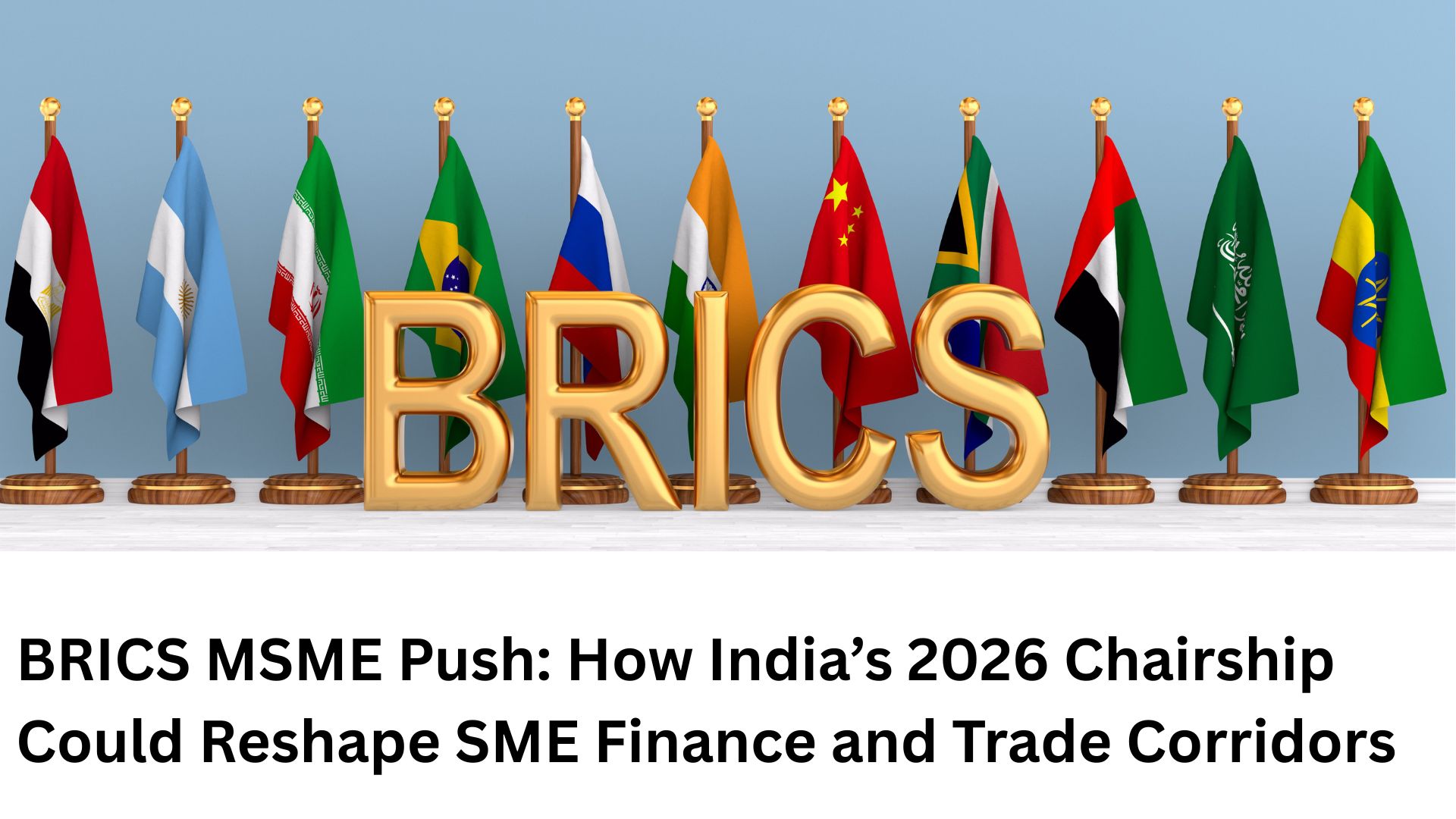
At a time when global trade is becoming increasingly fragmented and financing conditions remain uneven for small businesses, India’s decision to place MSME cooperation at the centre of its BRICS Chairship in 2026 carries far greater significance than a routine diplomatic initiative. It signals an attempt to build alternative economic linkages at a moment when emerging economies are searching for more resilient growth frameworks.
The first BRICS SME Working Group Meeting, convened virtually on April 24 under the BRICS Partnership on the New Industrial Revolution (PartNIR), focused on one of the most persistent challenges facing small businesses across developing economies: access to finance. But beneath the official agenda lies a much larger strategic shift. India is positioning MSMEs not merely as domestic growth engines, but as critical actors in shaping future trade corridors, digital commerce ecosystems, and cross-border industrial cooperation among emerging economies.
Why MSME Finance Has Become a Strategic Issue
Across BRICS economies, MSMEs contribute significantly to employment generation, manufacturing activity, exports and regional development. Yet access to affordable and timely credit continues to remain one of the sector’s largest structural constraints.
India’s own MSME ecosystem illustrates this paradox clearly. The country has over 6 crore MSMEs contributing nearly 30% to GDP and close to half of total exports, yet many small enterprises continue to operate with limited formal financing access. Traditional lending models often struggle to assess smaller firms with limited collateral, fragmented financial records or informal operational structures.
This financing gap becomes even more problematic during periods of global uncertainty. Rising input costs, supply chain disruptions, currency volatility and slowing demand cycles disproportionately affect smaller businesses because they operate with thinner liquidity buffers.
The discussions during the BRICS Working Group meeting acknowledged this reality directly. The emphasis on financial inclusion, credit readiness and fintech-led financing reflects a growing understanding that future MSME resilience will depend as much on financial infrastructure as on industrial policy itself.
India’s Digital Finance Model Is Becoming an Exportable Framework
One of the most important dimensions of the BRICS discussions is the increasing interest in fintech-driven credit ecosystems. India enters these conversations with a relatively strong advantage.
Over the past decade, India has built a large-scale digital public infrastructure ecosystem around Aadhaar, UPI, GST-linked data systems, account aggregators and digital lending frameworks. Together, these systems have started reshaping how small businesses access formal finance.
This matters because many developing economies face similar challenges around credit assessment, financial inclusion and SME formalisation.
As BRICS economies explore deeper cooperation, India’s fintech infrastructure model could gradually evolve into a reference framework for other emerging markets seeking scalable SME financing solutions. The focus on seamless global trade payments during the discussions also points toward a broader ambition: reducing friction in cross-border transactions for smaller businesses.
In practical terms, easier payment systems, interoperable digital finance networks and faster settlement mechanisms could lower barriers for SMEs participating in international trade.
A Potential Shift in Trade Corridors
The geopolitical backdrop makes these developments particularly important.
Global trade corridors are increasingly being reshaped by supply chain diversification, protectionist policies and regional economic realignments. Businesses across the world are actively seeking alternative sourcing destinations and diversified trade partnerships to reduce concentration risk.
For Indian MSMEs, stronger BRICS cooperation could open access to newer export markets beyond traditional dependence on North America and Europe.
Trade relationships within BRICS nations already span sectors such as pharmaceuticals, engineering goods, chemicals, agricultural products, digital services and manufacturing inputs. However, smaller businesses have often struggled to fully participate in these opportunities because of financing limitations, regulatory barriers and payment complexities.
If BRICS cooperation evolves into more integrated financing and trade support mechanisms, Indian MSMEs could benefit from improved export connectivity across fast-growing emerging markets in Asia, Africa, Latin America and parts of Eurasia.
This becomes especially valuable during periods of global volatility when diversified trade exposure acts as a stabilising factor for exporters.
From Policy Dialogue to Institutional Cooperation
What distinguishes the current BRICS MSME discussions is the movement away from broad political declarations toward more operational cooperation.
The proposed BRICS MSME Forum, expected later during India’s Chairship, could become an important platform for institutional partnerships, fintech collaboration, credit guarantee frameworks and digital trade integration discussions.
There is also growing potential for collaboration in areas such as supply chain financing, green industrial financing, digital compliance systems and SME-focused innovation ecosystems.
For India, this aligns closely with broader economic priorities around manufacturing expansion, export diversification and strengthening domestic supply chains.
At the same time, BRICS economies themselves are searching for more internally resilient growth networks as global economic fragmentation intensifies.
Why This Matters Beyond Diplomacy
The significance of these developments lies in the timing. Global growth remains uneven, trade tensions continue across major economies and financing conditions for smaller firms remain challenging worldwide.
In such an environment, MSME cooperation is no longer just a development agenda. It is increasingly becoming an economic resilience strategy.
India’s BRICS Chairship appears to recognise this shift. By placing MSME finance and fintech-enabled trade ecosystems at the centre of discussions, India is attempting to shape a more interconnected growth framework among emerging economies.
For Indian MSMEs, the long-term opportunity is not limited to easier access to credit. It is the possibility of becoming more deeply integrated into new trade corridors that may define the next phase of global economic growth.
And in a world where supply chains, capital flows and trade relationships are being constantly recalibrated, that positioning could become strategically important for India’s broader economic ambitions.