



WORLD MSME DAY 2026 SPECIAL | SME COMMUNITIES EXCLUSIVE
The New Business Imperative: Why Risk Awareness Is Becoming Every MSME’s Competitive Advantage
Every year on 27 June, the United Nations commemorates Micro-, Small and Medium-sized Enterprises (MSME) Day, recognising the critical role MSMEs play in driving innovation, employment, entrepreneurship and sustainable economic development across the world. The 2026 observance comes at a time when small businesses are navigating an increasingly dynamic global landscape shaped by digital transformation, climate-related events, geopolitical uncertainty, evolving supply chains and changing customer expectations.
For India, the significance of World MSME Day is even greater. With more than six crore MSMEs contributing substantially to employment, exports and economic growth, building resilient enterprises is no longer just a business imperative—it is central to India’s long-term development journey.
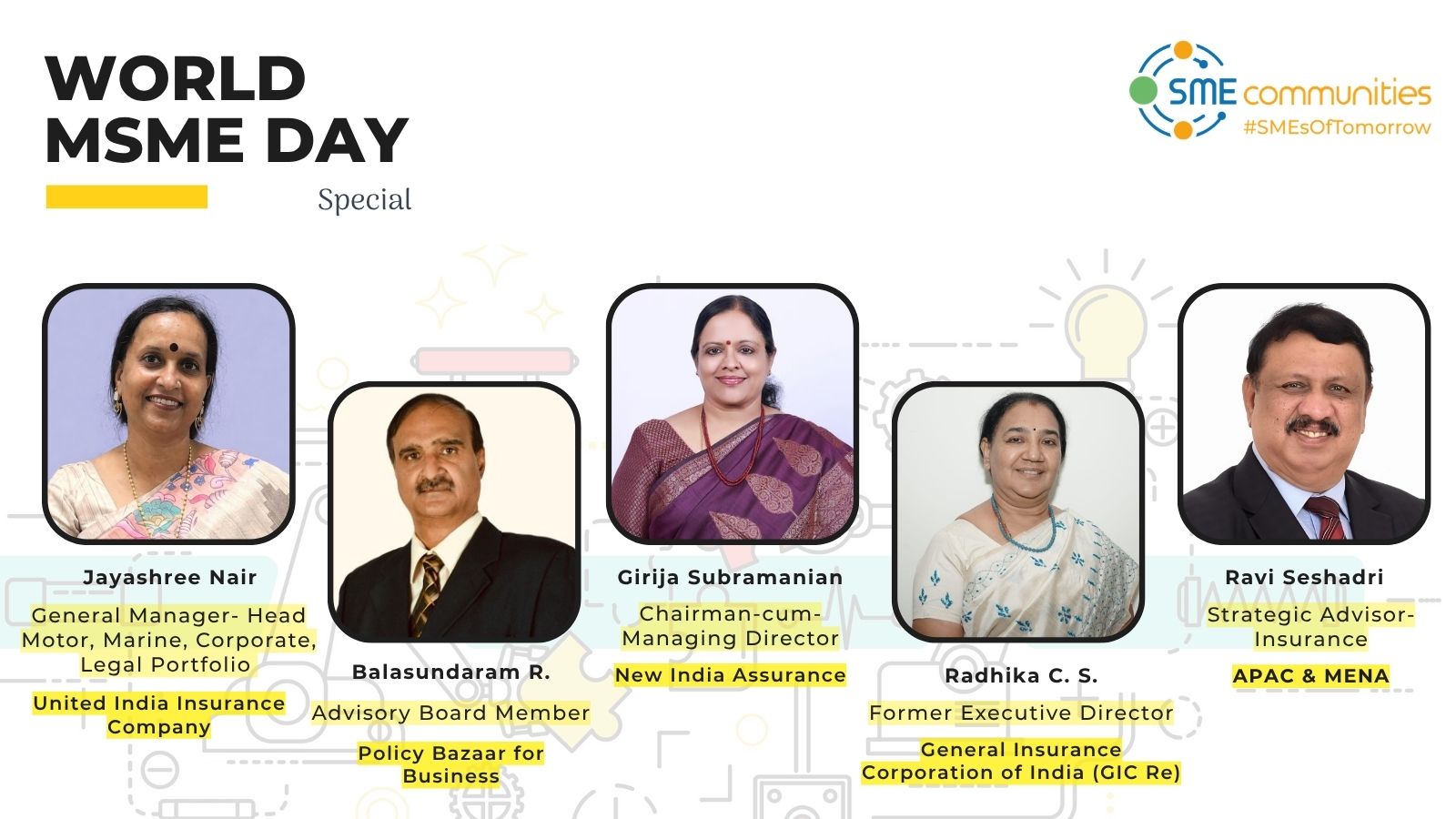
Against this backdrop, SME Communities reached out to five distinguished leaders from India’s general insurance and risk management ecosystem to understand how entrepreneurs can prepare for a future where resilience is becoming as important as growth.
Although each leader brings a unique perspective: from insurance, reinsurance, broking and risk advisory to InsurTech and their collective insights underscore an important reality that businesses which anticipate risk, prepare for uncertainty and embed resilience into their decision-making will be best positioned to thrive in the years ahead.
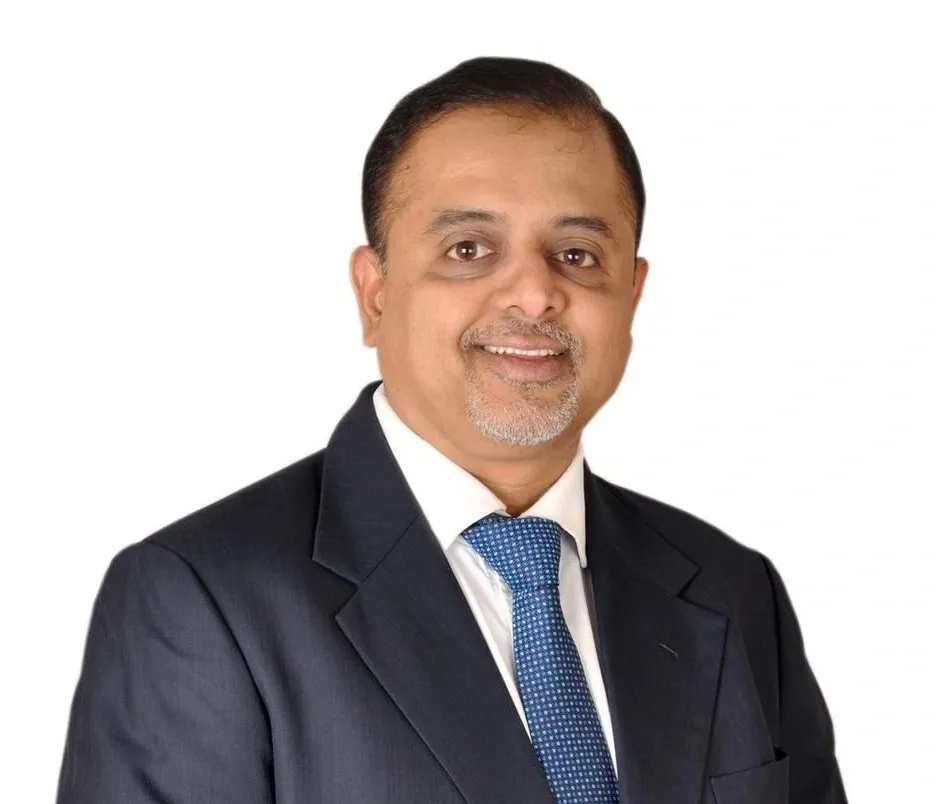
Girija Subramanian, Chairman & Managing Director, New India Assurance Company Limited
SME Communities : As the CMD of New India Assurance, you have had the privilege of serving India’s business community, including millions of MSMEs, across diverse industries and economic cycles. Drawing upon this unique experience, what are the most common risks you believe MSMEs continue to underestimate, and what advice would you offer entrepreneurs on World MSME Day to build businesses that are not only successful, but also resilient for the long term?
Having served businesses across sectors and geographies, one insight stands out consistently: successful MSMEs are not necessarily those that encounter fewer risks, they are those that prepare better for them.
Over the years, we have seen enterprises affected by fires, floods, machinery breakdowns, cargo losses, liability claims, cyber incidents and supply-chain disruptions. In many cases, the financial impact extends well beyond the immediate loss and affects business continuity, customer confidence and future growth.
At the same time, we have also seen numerous MSMEs recover quickly because they had adopted sound risk management practices and appropriate insurance protection as part of their business planning.
My message on World MSME Day is that resilience should become a strategic priority for every entrepreneur. Building a successful enterprise is about pursuing growth, but building a lasting enterprise is about preparing for uncertainty. Businesses that combine innovation with resilience will be best positioned to contribute to India’s vision of becoming a developed economy by 2047.
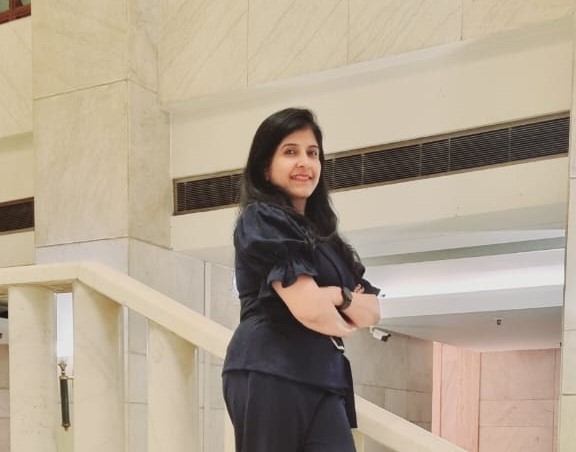
Jayashree Nair, General Manager & Head – Motor, Marine, Corporate & Legal, United India Insurance Company
SME Communities: Having worked extensively with businesses across sectors during your distinguished career at United India Insurance, how have you seen the risk profile of Indian MSMEs evolve over the years? More importantly, how can entrepreneurs use insurance not merely as financial protection, but as a strategic business tool to support sustainable growth and competitiveness?
The risk environment for MSMEs has evolved considerably over the past decade. Earlier, businesses primarily focused on protecting physical assets such as factories, machinery and inventories. Today, the business environment has become far more complex with risks ranging from business interruption, cyber risks, employee wellbeing, liability exposures and increasingly complex supply chains.
This changing risk landscape has transformed the role of insurance. Insurance should not be viewed only as a mechanism for settling claims after an unfortunate event. It should be an integral part of business strategy and risk management from the beginning
Whether it is safeguarding manufacturing facilities, securing goods in transit, protecting employees or enabling continuity after an unexpected disruption, appropriate insurance solutions empower entrepreneurs to take informed business decisions with greater confidence.
On World MSME Day, my message is that resilient businesses are built not only through innovation and investment, but also through thoughtful risk management. Insurance is not just a financial safeguard- it is a strategic enabler that provides confidence to Entrepreneurs to grow, invest and compete in an increasingly dynamic business ecosystem
Balasundaram R., Advisory Board Member – Policybazaar for Business
SME Communities: Having spent decades advising businesses on risk financing and insurance, first as Secretary General of the Insurance Brokers Association of India (IBAI) and now as an Advisory Board Member at Policy Bazaar for Business, you have witnessed the evolution of India’s corporate insurance landscape. On World MSME Day, what do you believe is the biggest misconception MSMEs have about insurance, and how can they leverage professional risk advisory to build stronger and more sustainable businesses?
One of the biggest misconceptions among MSMEs is that insurance is simply a statutory requirement or something purchased only because a bank insists on it while extending credit. In reality, insurance should be viewed as an integral part of business risk management. It is also important to recognise that the MSME sector is far from homogeneous. According to the IBAI–McKinsey Report 2025, India has over six crore MSMEs, but nearly 5.8 crore have annual turnover below ₹1 crore. Their risk perceptions, financial capacity and insurance needs are vastly different from businesses with turnovers between ₹1 crore and ₹50 crore.
For many MSMEs, insurance is bought only when mandated or linked to bank finance, with the focus often being on minimising cost rather than ensuring adequate protection. This stems from low margins, limited awareness, lack of trust, past claim experiences and the belief that “nothing will happen to my business.”
This is where professional risk advisory makes the difference. Every business has a unique risk profile, and the role of the advisor is not merely to recommend an insurance policy but to help businesses understand, manage and transfer risks appropriately. Advisors also play a critical role in working with insurers to develop products and claims processes that better suit small businesses. Innovative approaches such as parametric insurance or cluster-based insurance solutions could significantly improve protection for MSMEs.
As Indian businesses become larger and more integrated into global supply chains, I believe professional risk advisory will become as essential as financial or legal advisory. Ultimately, insurance is only one component of risk management, and sustainable businesses will be those that understand their risks and manage them proactively rather than simply buying the cheapest policy.
Radhika Kumar, Former Executive Director, GIC Re
SME Communities: During your distinguished career at GIC Re, you evaluated risks not just at the level of individual businesses but across entire industries, geographies and catastrophic events. From that unique vantage point, what lessons should India’s MSMEs learn about preparing for an increasingly interconnected world where climate events, cyber incidents, supply-chain disruptions and geopolitical developments can simultaneously affect business continuity?
One of the biggest changes I have witnessed over the years is that business risks rarely occur in isolation anymore.
A flood can disrupt manufacturing, interrupt supply chains, affect logistics, delay exports and ultimately impact cash flows. Similarly, a cyber incident can quickly evolve into operational, financial and reputational challenges. The interconnected nature of today’s risks means that resilience can no longer be built by addressing one exposure at a time.
For MSMEs, this requires a more holistic approach to risk management. Entrepreneurs should regularly assess the vulnerabilities within their operations, diversify critical dependencies wherever possible and ensure that appropriate insurance protection forms part of a broader resilience strategy.
From a reinsurance perspective, we often say that the objective is not merely to absorb losses after an event, but to ensure that economies and businesses can recover, rebuild and continue creating value.
On World MSME Day, my message is that resilience is becoming a competitive advantage. Businesses that anticipate uncertainty, invest in preparedness and strengthen their risk culture will be better equipped to seize opportunities in an increasingly complex global economy.
Dr. Ravi Seshadri, Strategic Advisor – Insurance, APAC & MENA
SME Communities: Having led insurance businesses across India and international markets while closely witnessing the rise of InsurTech and digital risk management, how do you see technology transforming the way MSMEs understand, manage and finance risk? More importantly, why do you believe risk awareness itself is becoming a strategic capability for every entrepreneur?
The biggest shift I have witnessed over the past decade is that technology is democratising risk management. Traditionally, sophisticated risk assessment and insurance solutions were largely accessible to large corporates. Today, advancements in InsurTech, artificial intelligence, data analytics and digital platforms are making these capabilities increasingly available to MSMEs as well.
This is a significant opportunity because risk management should not begin with purchasing insurance, it should begin with understanding the risks that could affect the continuity, profitability and reputation of a business.
Technology now enables entrepreneurs to identify vulnerabilities earlier, make more informed decisions and access more appropriate risk financing solutions. However, technology alone is not enough. It must be supported by a culture of risk awareness. Entrepreneurs who understand risk are better equipped to innovate, expand confidently into new markets and respond effectively to unexpected disruptions.
On World MSME Day, my message is that the most valuable investment an MSME can make is not only in technology or capital, but also in building a culture where risk awareness becomes an integral part of every business decision.
SME Communities’ Closing Perspective
As India celebrates World MSME Day 2026, the perspectives shared by these five distinguished leaders reinforce a common theme. While their experiences span insurance, reinsurance, broking, advisory and technology, they all point towards the same conclusion: resilience is no longer a defensive concept, it is a strategic business capability.
For India’s MSMEs, the future will not be shaped by growth alone. It will be shaped by the ability to understand risk, prepare for uncertainty and build enterprises that can adapt to an increasingly interconnected world.
On this World MSME Day, that may be the most important message of all.