




Parliament Passes Taxation Laws Amendment Bill: Why India’s Electronics Manufacturing SMEs Should Be Paying Attention
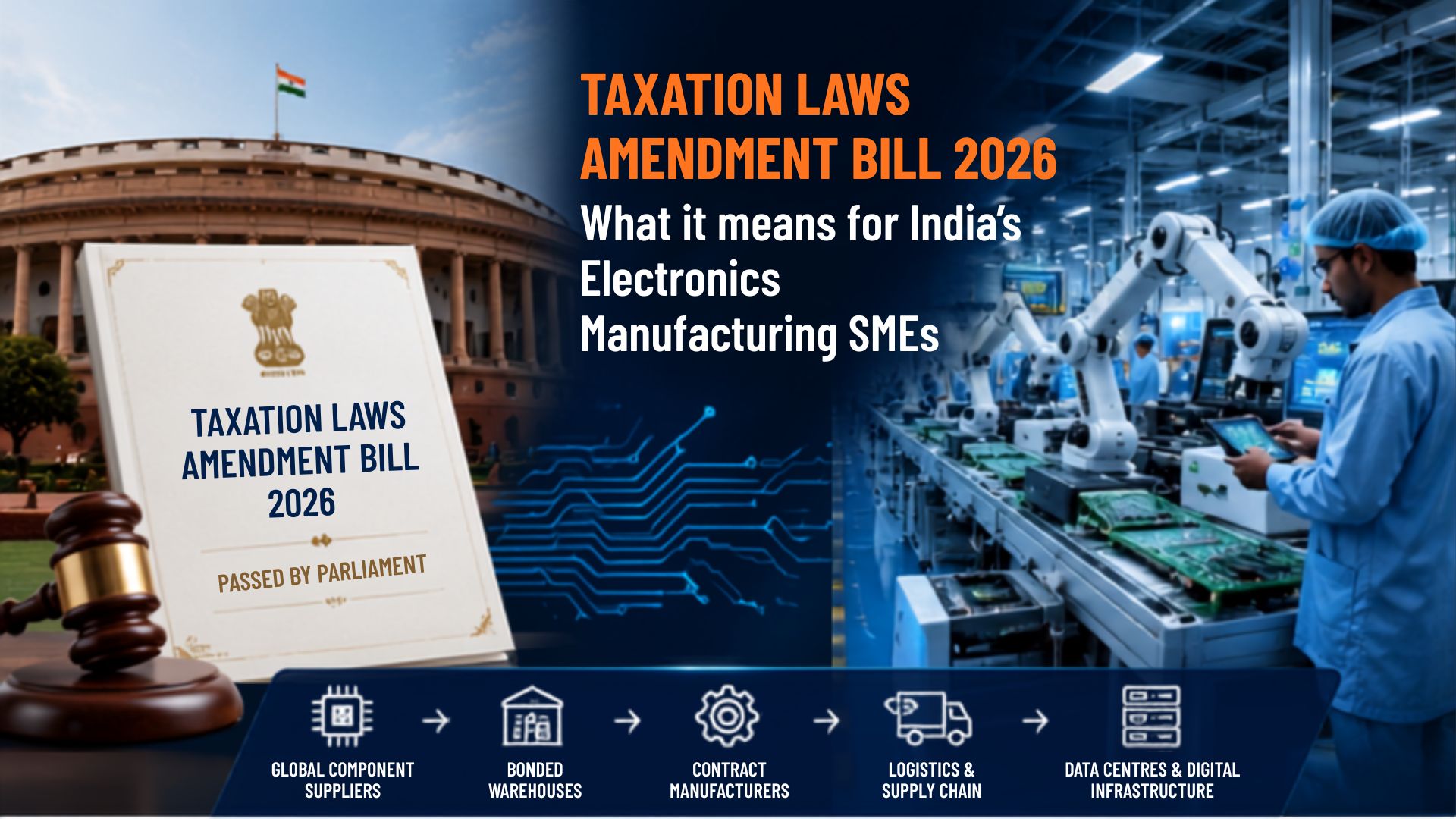
Parliament’s passage of the Taxation and Other Laws (Amendment) Bill, 2026 marks more than the replacement of an ordinance issued earlier this year. While the legislation has largely been discussed for introducing tax exemptions for eligible foreign investors in government securities, it also contains a series of amendments that could quietly reshape India’s electronics manufacturing and digital infrastructure ecosystem over the next decade.
For India’s SME community, the significance of these provisions lies not in direct tax benefits, but in the investment environment they seek to create. By extending policy certainty, simplifying tax conditions for specified foreign companies and encouraging long-term investment in manufacturing and digital infrastructure, the legislation reinforces India’s ambition to become a globally competitive manufacturing destination. For thousands of MSMEs operating across the electronics value chain, this is a development worth paying attention to.
Building Manufacturing Ecosystems, Not Just Factories
Modern electronics manufacturing is no longer built around standalone factories. Every smartphone, laptop, server or networking device assembled in India relies on an extensive ecosystem of component manufacturers, tooling companies, precision engineering firms, logistics providers, warehouse operators, testing laboratories, automation specialists and technology partners. Much of this ecosystem is powered by SMEs.
India’s industrial strategy increasingly reflects this reality. The objective is no longer limited to attracting global brands to assemble products in India, but to encourage the entire supplier network that enables manufacturing at scale. The amendments approved by Parliament should therefore be viewed as part of a broader effort to strengthen the country’s manufacturing ecosystem rather than as isolated tax measures.
Creating a Longer Investment Horizon
One of the Bill’s most significant provisions extends the tax exemption relating to foreign-owned tooling and machinery supplied to Indian contract manufacturers until 31 March 2041. The relief applies to the manufacture of specified electronic products such as mobile phones, laptops, personal computers, tablets, servers and their components.
For multinational manufacturers, investments in tooling, production lines and supplier development are planned over decades. A longer policy horizon reduces uncertainty and provides greater confidence when evaluating manufacturing locations.
While the tax relief is available to specified foreign companies rather than Indian manufacturers, its importance extends much further. Long-term commitments from global manufacturers typically translate into sustained demand for domestic suppliers. SMEs involved in precision engineering, component manufacturing, tooling, industrial automation, testing and specialised fabrication become integral partners in these expanding production ecosystems.
Why a Tax Benefit for Foreign Companies Matters to Indian SMEs
A natural question for many business owners is why a tax amendment benefiting foreign companies should matter to Indian manufacturers.
The answer lies in the way global supply chains function.
Consider an Indian SME assembling electronic modules or manufacturing printed circuit boards for an international brand. Its production depends on specialised semiconductors, sensors, connectors or electronic components sourced from global suppliers. If those suppliers maintain inventory outside India in regional hubs such as Singapore or Malaysia, critical components may take weeks to reach production lines, increasing procurement costs and disrupting manufacturing schedules.
The Bill seeks to reduce these operational bottlenecks by providing tax certainty for specified foreign companies maintaining inventory in customs-bonded warehouses for supply to Indian contract manufacturers. Rather than shipping components only after orders are placed, global suppliers are encouraged to position inventory closer to manufacturing facilities in India.
The immediate tax benefit accrues to the foreign supplier, but the operational advantage flows across the domestic value chain. Faster component availability, shorter procurement cycles, improved production planning and greater supply chain resilience can significantly benefit Indian SMEs operating as contract manufacturers, component suppliers or logistics & warehousing partners.
Supporting Supply Chains Through Better Logistics
Another important amendment exempts income arising from the storage of specified electronic components in customs-bonded warehouses before they are supplied to Indian contract manufacturers.
Although technical in nature, this provision addresses one of the most critical aspects of modern manufacturing inventory management.
Electronics manufacturing increasingly operates on just-in-time production models, where components arrive exactly when required rather than being stored in large volumes inside factories. A more efficient tax framework for bonded warehousing supports quicker movement of components, reduces supply chain friction and enables manufacturers to respond faster to market demand.
For SMEs integrated into export-oriented manufacturing, these operational efficiencies can improve delivery timelines, inventory management and competitiveness in global supply chains.
Strengthening the Digital Backbone of Manufacturing
The legislation also introduces significant changes relating to India’s data centre sector by removing multiple approval-related conditions attached to tax exemptions for specified foreign companies procuring services from Indian data centres. The exemption has also been expanded to include facilities that are leased and operated by Indian companies, with the framework remaining valid until 31 March 2041.
Although the provision is directed at foreign companies, its implications extend across India’s digital economy.
Manufacturing today increasingly depends on cloud computing, industrial automation, artificial intelligence, predictive maintenance, digital twins and connected production systems. As factories become more technology-driven, data centres are emerging as critical industrial infrastructure rather than standalone technology assets.
This creates opportunities for a wide range of SMEs engaged in electrical engineering, power systems, cooling technologies, networking, industrial construction, cybersecurity, facility management and maintenance services, all of which form part of the expanding digital infrastructure ecosystem.
The Larger Policy Direction
Taken together, the amendments signal a broader shift in India’s industrial policy.
Rather than relying solely on direct incentives for manufacturers, the legislation focuses on reducing policy friction and creating an environment where global suppliers, contract manufacturers and technology companies can establish deeper and longer-term operations in India. The objective is not simply to attract investment into individual factories, but to strengthen the ecosystems that surround them.
For SMEs, this distinction is significant. The legislation does not provide immediate tax exemptions to domestic manufacturers. Instead, it seeks to create conditions that encourage multinational companies to invest, source and maintain operations within India decisions that often generate business opportunities for domestic suppliers throughout the manufacturing value chain.
More Than a Tax Amendment
Viewed purely through the lens of taxation, the Taxation and Other Laws (Amendment) Bill, 2026 appears to be a technical piece of legislation. Viewed from the perspective of industrial development, however, it reflects a broader strategy to make India’s manufacturing ecosystem more competitive, integrated and investment-ready.
As global companies increasingly evaluate manufacturing destinations based on the strength of local supplier networks, digital infrastructure and supply chain resilience, India’s SMEs will play a defining role in that equation. The real significance of the Bill therefore lies not only in the tax exemptions it introduces, but in the long-term manufacturing ecosystems it seeks to enable. For electronics manufacturers, component suppliers, engineering firms and technology partners, the legislation serves as another indication that India’s next phase of industrial growth will be driven as much by stronger value chains as by larger factories.