



India-Poland Trade Corridor: Why Central Europe’s Economic Powerhouse Is Emerging as India’s Next Strategic Gateway
India and Poland may be separated by more than 5,000 kilometres, but recent developments suggest the distance between their economic ambitions is shrinking rapidly. As policymakers and businesses on both sides explore deeper cooperation in trade, manufacturing, technology and MSME development, a relatively underreported trade corridor is beginning to attract strategic attention.
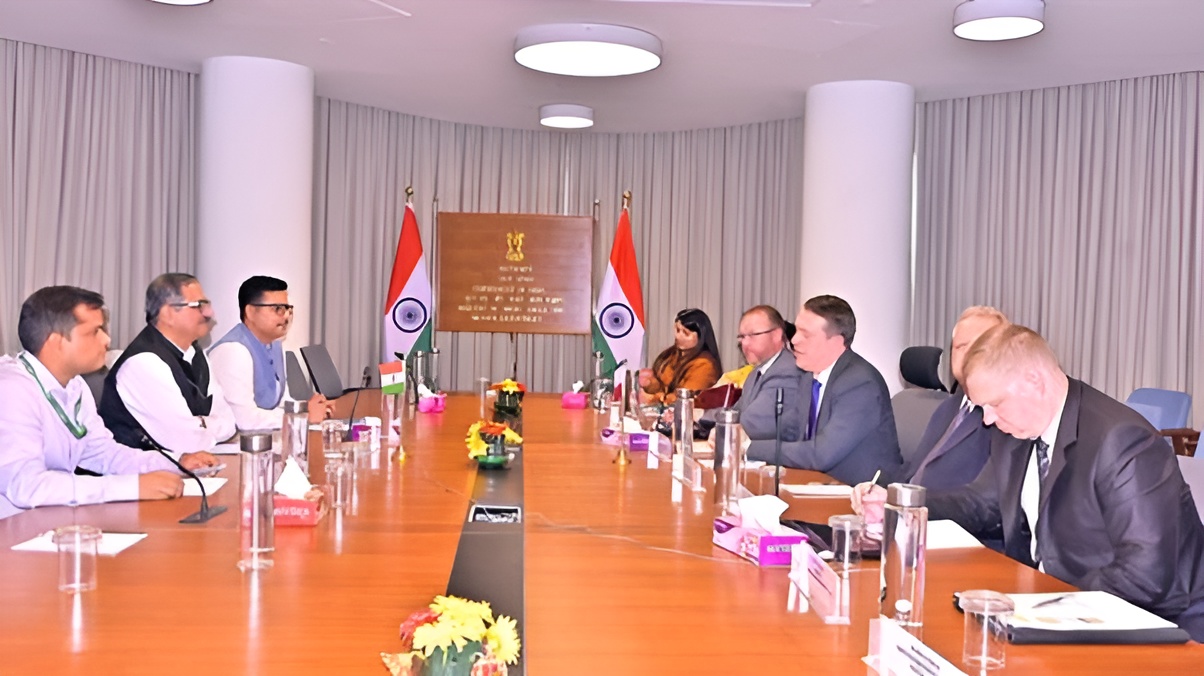
The latest signal came on 15 July 2026, when India’s Ministry of Micro, Small and Medium Enterprises hosted a high-level Polish delegation led by Michał Baranowski, Deputy Minister at Poland’s Ministry of Economic Development and Technology. During the meeting, MSME Secretary Bharat Khera described Poland as India’s largest trading and investment partner in Central and Eastern Europe and highlighted that bilateral trade had tripled between 2013 and 2025.
While the discussions focused on enterprise development, innovation, technology adoption and market access, the significance of the engagement extends beyond MSME cooperation. It reflects a broader economic reality: Poland is increasingly becoming one of India’s most important entry points into Europe at a time when global supply chains are being redrawn and the India-European Union economic relationship is entering a new phase.
A Relationship Built on Steady Economic Momentum
India and Poland established diplomatic relations in 1954, but economic engagement accelerated significantly after Poland joined the European Union in 2004. EU membership transformed Poland into one of Europe’s fastest-growing industrial economies, attracting investment across automotive manufacturing, machinery, electronics, chemicals and logistics.
The numbers illustrate the scale of progress. According to data from the Embassy of India in Warsaw, bilateral trade has grown from approximately US$2 billion in 2013 to more than US$6.3 billion in 2025. Indian exports reached nearly US$4.8 billion last year, while imports from Poland stood at around US$1.5 billion, giving India a substantial trade surplus.
More importantly, the growth has not been driven by commodities alone. Unlike many emerging market trade relationships that depend heavily on raw materials, India-Poland commerce is increasingly concentrated in value-added sectors such as engineering goods, machinery, automotive components, pharmaceuticals, chemicals, industrial equipment and technology-enabled services.
This diversification makes the corridor inherently more resilient and positions it for long-term growth.
Why Poland Matters More Than Most Indian Businesses Realise
For many Indian exporters, Europe is often viewed through the lens of Germany, France, Italy or the Netherlands. Yet Poland’s economic transformation over the past two decades has quietly altered the continent’s industrial geography.
According to Eurostat and World Bank data, Poland’s economy has expanded from approximately US$255 billion in 2004 to nearly US$950 billion in 2025, making it the sixth-largest economy in the European Union and the largest in Central and Eastern Europe. The country has consistently outperformed many European peers in economic growth, manufacturing output and industrial investment.
Poland’s strategic location has been equally important. Situated at the crossroads of Western and Eastern Europe, the country serves as a critical logistics and distribution hub connecting Germany, the Baltic states, Scandinavia and the wider European market. Major multinational corporations increasingly use Poland as a manufacturing and warehousing base for serving the European Union’s 450-million-consumer market.
For Indian businesses, this creates a compelling proposition. Accessing Poland increasingly means accessing Europe.
The Manufacturing Realignment Creating New Opportunities
Global manufacturing is undergoing one of its most significant transformations in decades. Rising geopolitical tensions, supply chain disruptions and the push for economic resilience have encouraged companies to diversify production networks and reduce dependence on concentrated manufacturing hubs. Poland has emerged as one of the key beneficiaries of this trend.
According to the Polish Investment and Trade Agency (PAIH) and EY’s European Investment Monitor, Poland consistently ranks among Europe’s leading destinations for greenfield industrial investments. Significant capital has flowed into automotive manufacturing, battery production, semiconductor-related activities, industrial automation and advanced engineering.
At the same time, India is positioning itself as a global manufacturing destination through initiatives such as Make in India, PM Gati Shakti, the Production Linked Incentive (PLI) schemes and logistics reforms.
The convergence of these two industrial growth stories creates opportunities for deeper collaboration in engineering, machinery, auto components, electronics, industrial technologies and supply chain integration. Increasingly, the corridor is evolving from a traditional buyer-seller relationship into a partnership between two manufacturing ecosystems.
Why MSMEs Could Become the Biggest Beneficiaries
One of the most significant outcomes of the recent bilateral discussions is the growing recognition that MSMEs could become the driving force behind future economic cooperation.
India’s MSME sector comprises more than 86 million registered enterprises and contributes nearly 30% of GDP, over one-third of manufacturing output and almost half of India’s exports. According to the Ministry of MSME, the sector supports approximately 330 million livelihoods and remains central to India’s industrial and export ambitions.
Poland presents a remarkably similar economic structure. According to the Polish Agency for Enterprise Development (PARP), SMEs account for more than 99% of businesses operating in the country and contribute nearly 50% of GDP. Much of Poland’s industrial competitiveness is built on specialised suppliers, technology-focused enterprises and export-oriented manufacturing firms.
This structural similarity creates natural opportunities for collaboration. Indian MSMEs can benefit from technology partnerships, distribution networks, engineering collaborations and market access initiatives, while Polish firms gain access to India’s growing industrial base and expanding domestic market. The institutional cooperation framework established between India’s National Small Industries Corporation (NSIC) and PARP is expected to play a critical role in facilitating these connections.
The India-EU FTA Could Be a Game Changer
The recently concluded India-European Union Free Trade Agreement could significantly accelerate the growth trajectory of the India-Poland corridor.
The European Union is among India’s largest trading partners, with bilateral trade in goods and services exceeding €120 billion annually. Trade experts expect the agreement to reduce tariff barriers, simplify compliance requirements and improve market access across sectors ranging from engineering goods and pharmaceuticals to digital services and renewable energy technologies.
Within this new framework, Poland’s importance is likely to increase. As a major manufacturing and logistics hub within the EU, the country offers Indian exporters a strategically located platform for reaching multiple European markets. Sectors such as electric mobility, green hydrogen, defence manufacturing, industrial automation, advanced machinery and clean technologies are expected to emerge as areas of growing cooperation.
A Corridor Worth Watching
Trade corridors rarely emerge overnight. They develop when geography, policy, industrial capability and economic priorities align. Increasingly, the India-Poland relationship exhibits all four characteristics.
A rapidly growing India seeking new export markets, a rising Poland serving as Europe’s industrial crossroads, strengthening institutional cooperation and a favourable India-EU trade framework are creating the foundations for a much deeper partnership.
The recent MSME dialogue in New Delhi may have focused on enterprise development, but its implications extend far beyond small business cooperation. What is taking shape is a corridor that links India’s manufacturing ambitions with Europe’s evolving industrial landscape.