




The Missing Layer in India’s Manufacturing Story
India’s manufacturing ambitions have never been bigger. From semiconductors and electric vehicles to drones, batteries, aerospace and artificial intelligence, industrial policy over the last few years has been centred on positioning India as a global manufacturing powerhouse. Through initiatives such as the PLI Scheme, make in India, Semicon India and large-scale public infrastructure investments, the country is steadily building capabilities in industries expected to define the global economy over the next two decades.
As global supply chains diversify under the China-plus-one strategy, India has a rare opportunity to cement its position as a trusted manufacturing destination.
Every semiconductor fabrication plant, ev factory, robotics facility or aerospace production line depends on thousands of industrial products that rarely make newspaper headlines. If India wants to evolve from an assembly hub into a globally competitive manufacturing powerhouse, strengthening this industrial backbone could prove just as important as attracting investments into frontier technologies.
Manufacturing Is Built in Three Layers
Manufacturing ecosystems can broadly be viewed as a three-layer structure. The first layer comprises raw materials such as steel, aluminium, copper, industrial chemicals, petrochemicals and specialty materials. These industries provide the essential inputs that feed manufacturing supply chains.
The third layer is where most policy attention currently resides. It includes semiconductors, electronics, ev, batteries, aerospace, defence manufacturing, robotics and advanced digital technologies. These sectors represent the highest levels of value addition, innovation and strategic significance.
Between these two sits the largest and perhaps the most underestimated layer of manufacturing.
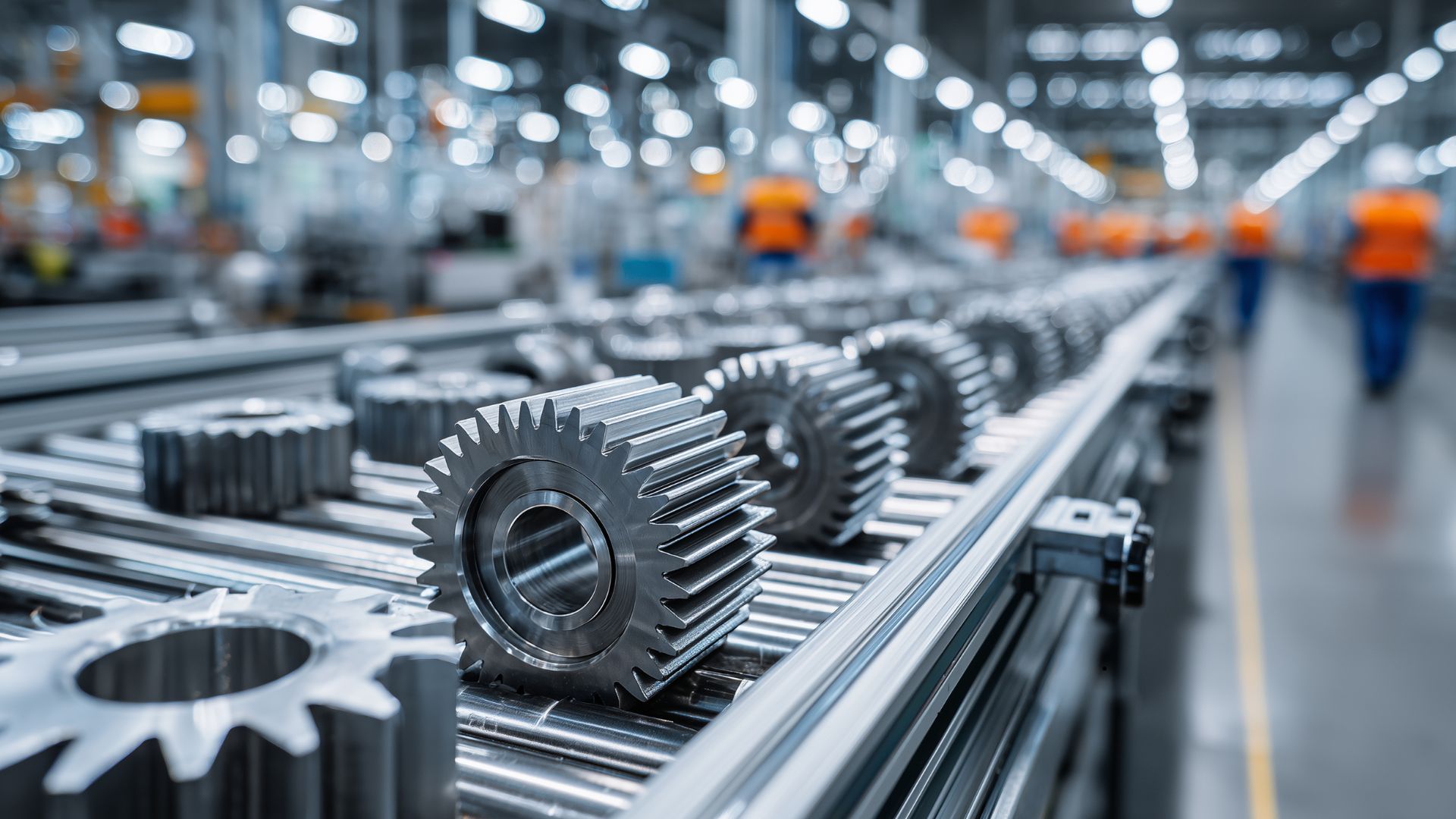
This middle layer consists of industrial backbone products including machine tools, bearings, pumps, valves, compressors, industrial motors, gearboxes, hydraulic systems, fasteners, transformers, industrial cables, dies, moulds, automation equipment and precision engineering components. These products rarely receive public attention because consumers seldom purchase them directly. Yet every manufacturing plant relies on them every single day. Without them, neither raw materials nor advanced technologies can be transformed into commercially viable products.
In many ways, this middle layer functions as the operating system of manufacturing. It determines how efficiently factories run, how much value addition stays within the domestic economy and how resilient supply chains remain during periods of global disruption.
The World’s Manufacturing Leaders Built Their Strength from the Middle
The experience of leading manufacturing economies demonstrates that industrial competitiveness is rarely built solely through flagship industries.
Germany’s globally respected Mittelstand is composed of thousands of highly specialised medium-sized manufacturers producing middle layer industrial components that support manufacturers across the world. Their success lies not in producing consumer brands but in becoming indispensable suppliers to global industry.
Japan followed a similar trajectory by investing for decades in machine tools, industrial robotics, precision bearings, tooling systems and advanced engineering before becoming synonymous with automobiles and consumer electronics. Likewise, China’s emergence as the world’s manufacturing powerhouse began long before ev or semiconductors. It first developed deep capabilities across capital goods, industrial equipment, tooling, chemicals, castings, forgings and engineering components that enabled every downstream industry to flourish.
The lesson is consistent across manufacturing leaders: advanced industries succeed because an equally advanced industrial backbone already exists. Manufacturing excellence is rarely built from the top down; it is built by strengthening the thousands of specialised industries that quietly support every factory, every production line and every supply chain.
India Has Started Building the Foundation, But the Gap Remains Significant
To suggest that India has overlooked the middle layer would be inaccurate. While semiconductors, electronics and electric mobility have dominated public discourse, policymakers have gradually strengthened the country’s capital goods and precision engineering ecosystem through targeted interventions. The Scheme for Enhancement of Competitiveness in the Indian Capital Goods Sector (Phase II) supports technology development, common engineering facility centres, testing infrastructure, advanced centres of excellence and workforce skilling. As of late 2025, 29 projects worth ₹891 crore had been sanctioned under the programme. The Union Budget 2026–27 further reinforced this direction by announcing Hi-Tech Tool Rooms, expanding support for precision manufacturing, introducing a ₹10,000 crore Container Manufacturing Scheme, and continuing the government’s infrastructure-led investment strategy with a record ₹12.2 lakh crore capital expenditure. Public capital outlay has increased more than fourfold from ₹2.63 lakh crore in FY18 to ₹11.21 lakh crore in FY26 (BE) creating sustained demand for domestically manufactured capital goods, engineering equipment and industrial machinery.
The impact of these efforts is beginning to become visible across the manufacturing landscape. According to the Ministry of Heavy Industries’ Annual Report 2025–26, domestic machine tool production more than doubled from ₹6,602 crore in FY2020-21 to ₹14,286 crore in FY2024-25. Production of dies, moulds and press tools increased from ₹12,294 crore to ₹18,400 crore, while process plant equipment expanded from ₹21,938 crore to ₹31,505 crore during the same period. These figures indicate that India’s industrial manufacturing capabilities are steadily strengthening and that domestic engineering companies are responding to rising demand from sectors such as automotive, electronics, defence and industrial infrastructure.
However, the same data also reveals the scale of the challenge ahead. Demand for advanced industrial equipment continues to outpace domestic manufacturing capacity. Machine tool imports surged from ₹5,965 crore in FY2020-21 to ₹18,686 crore in FY2024-25, overtaking domestic production. Imports of textile machinery doubled over the same period, while food-processing machinery imports increased more than fivefold. For a country aspiring to become a global manufacturing hub, these numbers highlight a critical opportunity. India’s industrial backbone is expanding, but significant dependence on imported high-precision equipment remains. Closing this gap will determine whether future investments in semiconductors, ev and advanced manufacturing translate into deeper domestic value addition or continue to rely on overseas industrial capabilities.
Every Semiconductor and EV Factory Depends on Thousands of Invisible Products
Semiconductors often dominate discussions around industrial policy, yet a semiconductor fabrication facility cannot operate with silicon wafers alone.
It requires ultraprecision machine tools, vacuum pumps, clean-room compressors, industrial gases, precision valves, chemical delivery systems, bearings, transformers, electric motors, automation equipment, process control instruments and sophisticated engineering services. These technologies are not peripheral they determine production efficiency, quality control and operational reliability.
The same principle applies to electric vehicles. Public discussions generally focus on battery chemistry, charging infrastructure and vehicle assembly. Yet every EV production line depends on CNC machines, industrial robots, injection moulds, gears, hydraulic systems, precision tooling, automation platforms and specialised engineering components that seldom receive public attention. When these products are imported, a significant share of manufacturing value leaves the domestic economy before the final product is even assembled.
Developing domestic capabilities across these industrial segments enables countries to capture a much larger share of manufacturing value while simultaneously strengthening supply-chain resilience, reducing foreign dependency and creating high-value engineering employment.
The Real Opportunity Lies with India’s MSMEs
Perhaps the strongest argument for strengthening the industrial backbone is that it naturally aligns with India’s MSME ecosystem.
Unlike semiconductor fabrication, which requires multi-billion-dollar investments and relatively few participants, industrial backbone manufacturing is populated by thousands of engineering MSMEs and mid-sized enterprises. India already possesses globally competitive capabilities in forgings, castings, fasteners, industrial valves, pumps, electrical equipment, machining, tooling and precision components. Many of these companies already supply global automotive, industrial, aerospace and engineering firms.
Strengthening these sectors would enable far more MSMEs to integrate into global manufacturing value chains not merely as contract manufacturers but as specialised technology suppliers. This is precisely how Germany’s Mittelstand became one of the world’s most competitive manufacturing ecosystems: by creating globally respected engineering companies serving industries rather than consumers.
As multinational companies diversify supply chains beyond China, India’s engineering MSMEs have an opportunity to occupy a far larger role within global manufacturing networks. However, doing so requires continued investment in advanced tooling, precision manufacturing, industrial automation, testing infrastructure and product innovation.
Building the Middle Layer Creates a Manufacturing Multiplier
One of the greatest advantages of investing in industrial backbone industries is their multiplier effect. A single world-class machine tool manufacturer simultaneously supports automotive, aerospace, defence, railways, electronics, renewable energy, healthcare equipment and industrial automation. Similarly, improvements in bearings, industrial valves, transformers or precision tooling immediately enhance productivity across hundreds of downstream sectors.
Unlike industry-specific incentives that primarily benefit one sector, investments in industrial backbone industries strengthen the manufacturing ecosystem as a whole. They encourage domestic value addition, improve technology diffusion, reduce import dependence, generate skilled employment and make Indian manufacturing more globally competitive.
This layer also accelerates innovation. Engineering companies that develop expertise in precision machining, industrial automation or advanced tooling often become the technology partners that enable emerging industries to scale faster. The middle layer therefore functions not only as manufacturing infrastructure but also as an innovation platform for future industrial growth.
The Next Phase of Manufacturing Needs Balance, Not Substitution
India’s focus on first layer is entirely justified. These industries will define future economic competitiveness and deserve sustained policy support. However, long-term manufacturing leadership will not be determined solely by what happens at the top of the value chain. It will also depend on the strength, depth and technological capability of the industrial ecosystem supporting it.
The next phase of industrial policy therefore need not replace frontier manufacturing with traditional engineering. Instead, it should ensure that both evolve together. Every semiconductor fab requires precision engineering. Every electric vehicle factory depends on machine tools. Every robotics manufacturer relies on industrial components. Every advanced manufacturing ecosystem begins with an industrial backbone that is often invisible but always indispensable.
India has already laid the foundation for becoming a global manufacturing economy. The challenge now is to deepen the layer that connects raw materials with advanced technologies. If the country can build globally competitive capabilities across machine tools, industrial equipment, precision engineering and capital goods with the same strategic intensity that it is applying to semiconductors and electronics, it will create something far more valuable than isolated manufacturing success.
It will build a complete manufacturing ecosystem one capable of competing not only on scale, but on technological capability, supply-chain resilience and sustained value addition. That is the difference between becoming a nation that manufactures products and becoming one that manufactures industrial strength itself.