



Why Successful Indian SMEs Stop Growing
India has no shortage of entrepreneurial ambition. But building a successful business and building an institution capable of sustained growth are two very different achievements.
India’s SME landscape is populated by enterprises that have accomplished something remarkable. They have survived intense competition, navigated economic uncertainty, established customer relationships and built profitable businesses, often with limited access to capital and professional talent.
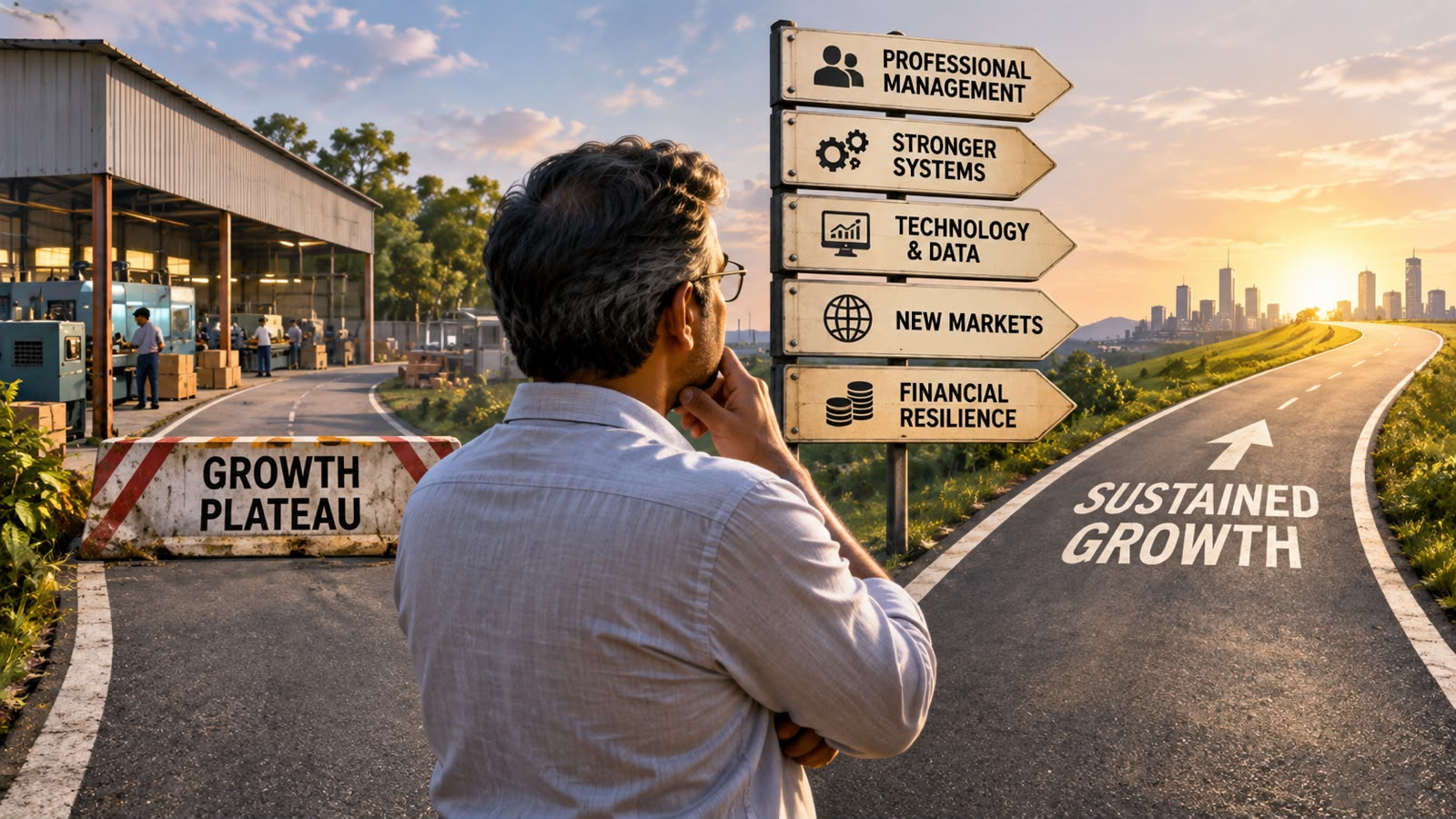
Yet many eventually encounter an uncomfortable reality: the business continues to operate, customers remain loyal and opportunities still exist, but meaningful growth becomes increasingly elusive.
Some enterprises plateau for years. Others expand their turnover without a corresponding improvement in profitability, productivity or competitiveness. Why do businesses that have demonstrated the ability to succeed find it so difficult to sustain that success at scale?
The answer often lies not in the market, but within the enterprise itself.
When entrepreneurial strength becomes organisational weakness
In the early years, the promoter is frequently the company’s greatest competitive advantage. Decisions are swift. Customer relationships are personal. Financial discipline comes from instinct, experience and direct supervision. Layers of management are unnecessary because the entrepreneur understands virtually every dimension of the business.
But the qualities that enable a company to establish itself do not automatically equip it for expansion. As operations become more complex, centralised decision-making creates friction. Managers hesitate to exercise authority. Opportunities await the promoter’s attention. Strategic decisions compete with routine operational matters.
The entrepreneur who once accelerated growth gradually becomes its principal constraint. This is not necessarily a failure of leadership. It is a failure to recognise that the organisation’s requirements have fundamentally changed.
The dangerous pursuit of turnover
For many SMEs, revenue remains the dominant measure of success. Larger orders, additional production lines and new customers create visible evidence of progress. But turnover is an imperfect indicator of institutional strength.
Growth can consume working capital faster than it generates profits. Large customers may demand extended payment terms. Inventory accumulates, borrowing increases and operating margins come under pressure.
A company can become substantially larger without becoming financially stronger. The distinction matters particularly in manufacturing and trading businesses, where expansion frequently requires considerable investment before revenues are realised.
The real measure of progress is not how much business an enterprise generates, but how effectively it converts that business into sustainable earnings, cash flow and competitive advantage.
Professional management without professional authority
Professionalisation is widely discussed across India’s SME ecosystem, yet its practical meaning is frequently misunderstood. Recruiting experienced executives is only the beginning. The more difficult task is creating an environment in which those executives can exercise judgement, accept accountability and influence strategy.
Promoters understandably hesitate to surrender control over enterprises built through years of personal sacrifice. Professional managers, meanwhile, can become frustrated when their responsibilities exceed their authority.
The result is an expensive compromise: the organisation acquires the appearance of professional management while retaining the operating habits of a founder-controlled business. True professionalisation does not diminish entrepreneurial leadership. It allows that leadership to operate at a higher strategic level.
The limits of familiar markets
Another constraint emerges when commercial success creates strategic complacency. An SME may possess strong manufacturing capabilities, dependable customers and a respected position within its industry, yet remain excessively dependent on a narrow customer base or established product portfolio.
Expanding into new markets demands capabilities that differ from those required to serve existing relationships. Exports require regulatory understanding, certifications and distribution networks. Higher-value products demand research, technical expertise and differentiation. New customer segments require market intelligence and sustained business development.
Investment in production capacity alone cannot deliver these capabilities. The uncomfortable question for many promoters is whether their companies are genuinely positioned for future markets or simply becoming more efficient at serving yesterday’s customers.
Technology is not a substitute for transformation
Digitalisation, automation and artificial intelligence promise significant productivity gains for Indian SMEs. But technology investments frequently disappoint when underlying management practices remain unchanged.
An ERP platform cannot create accountability. Automation cannot compensate for poor production planning. AI cannot generate reliable insights from fragmented or inconsistent business data. Technology amplifies organisational capability; it does not manufacture it.
The most successful transformation programmes therefore begin not with software selection, but with a fundamental examination of processes, responsibilities and decision-making.
The next frontier is institutional
India’s ambitions to become a globally competitive manufacturing and export economy depend significantly on the ability of its smaller enterprises to grow into stronger, more sophisticated businesses. Access to finance, infrastructure, technology and markets will remain essential. But these external enablers address only part of the challenge.
The harder transformation must occur inside the enterprise. Promoters must distinguish ownership from operational control, revenue expansion from value creation, and personal oversight from institutional governance. This does not mean abandoning the entrepreneurial instincts that built the business. It means creating structures capable of extending those instincts beyond the founder.
The defining challenge for India’s SMEs is no longer simply how to become successful businesses. It is how to avoid becoming permanently dependent on the very individuals who made them successful.
The next generation of Indian industrial champions will be distinguished not merely by what their founders have built, but by what their organisations can achieve without them.