




Lean Manufacturing: Why Indian MSMEs Need to Make Efficiency a Competitive Advantage
Lean manufacturing has long been associated with the production floors of large Japanese companies and global automotive giants. But the philosophy behind it is far more relevant to a small Indian factory than the terminology might suggest. At its core, lean manufacturing asks a simple business question: how can a company deliver greater value to its customer while using fewer resources and eliminating activities that do not add value?
For India’s micro, small and medium enterprises, that question is becoming increasingly important. Manufacturing MSMEs operate in an environment where margins can be tight, raw-material costs fluctuate, skilled manpower can be difficult to retain and customers increasingly expect better quality and faster deliveries. For businesses supplying larger companies or looking to enter global supply chains, offering a competitive price alone is no longer enough. Consistency, productivity, quality, delivery reliability and responsiveness are becoming equally important. This is where lean manufacturing can offer a practical advantage.
Beyond Cost-Cutting
Lean manufacturing is often misunderstood as a cost-cutting exercise. It is not about simply asking workers to produce more in less time or reducing manpower. Instead, it involves examining the production system and identifying where time, material, space, energy and human effort are being consumed without creating corresponding value for the customer.
Consider a typical manufacturing process. A component may spend only a few minutes actually being processed but could spend hours waiting for the next machine, moving between workstations, sitting in work-in-progress inventory or waiting for inspection. The customer pays for the component, not for the hours it spends waiting on the shop floor. Lean attempts to identify and eliminate these inefficiencies.
The philosophy has its roots in the Toyota Production System and is built around principles such as defining customer value, understanding the value stream, creating continuous flow, producing according to demand and continuously improving the process. For an Indian engineering MSME, reducing unnecessary material movement can free up shop-floor space, better workplace organisation can save operator time, preventive maintenance can reduce downtime, and stronger process controls can reduce rejection and rework.
None of these necessarily requires a large investment. They require visibility into the process and the discipline to address the causes of inefficiency.
Finding the Waste Hidden Inside the Factory
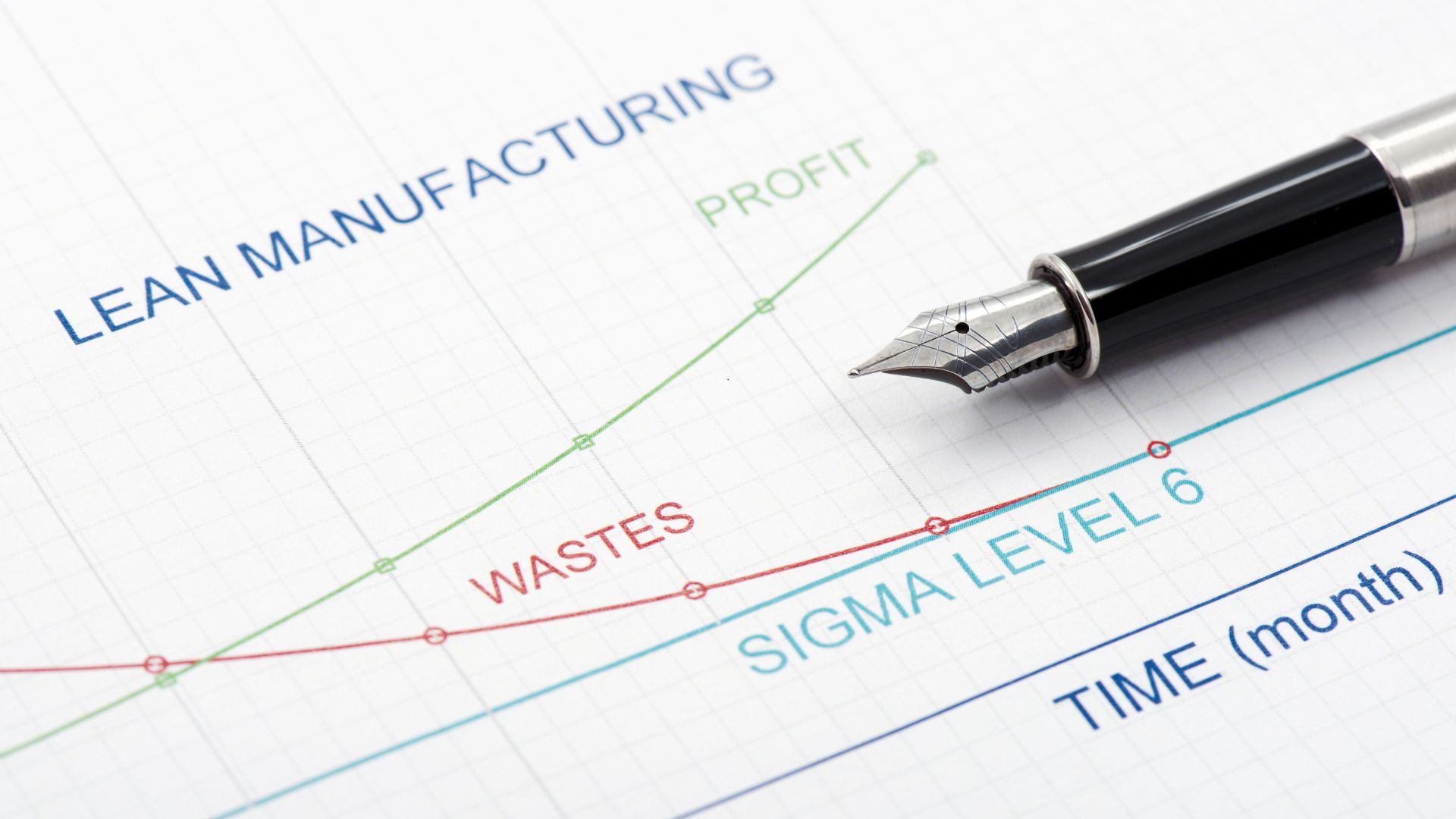
One of the most useful ways of understanding lean is through the concept of waste. Lean practitioners typically look at defects, overproduction, waiting, underutilisation of people, unnecessary transportation, excess inventory, unnecessary motion and over-processing.
For an MSME, these are not merely operational issues; they can directly affect profitability. Producing a batch before it is required ties up working capital. Excess inventory occupies valuable space and carries the risk of damage or obsolescence. Machine breakdowns disrupt production schedules, while repeated quality failures consume material and labour twice.
The bigger challenge is that these inefficiencies can become normalised. Rework becomes “part of the process”, frequent machine stoppages become something employees learn to work around and excess inventory is justified as a safety buffer.
The question is not simply whether a problem exists, but why the process allows that problem to occur repeatedly.
Why Lean Matters to Indian MSMEs
The competitive environment for Indian manufacturing is changing. As India seeks to strengthen its position in global manufacturing and integrate more deeply with international supply chains, MSMEs will increasingly have to meet the standards expected by large domestic companies, multinational corporations and overseas buyers.
An MSME supplying an automobile, electronics or engineering company may be expected to maintain consistent quality, meet strict delivery schedules and demonstrate reliable processes. For exporters, inefficiency at the factory level can ultimately make the product less competitive.
Productivity improvement, therefore, becomes more than an internal operational exercise. It becomes a business strategy.
The Government of India has recognised this through the MSME Competitive (Lean) Scheme, implemented by the Ministry of Micro, Small and Medium Enterprises. The scheme aims to improve domestic and global competitiveness by reducing rejection rates, production costs and unnecessary movement while improving quality, resource utilisation, workplace safety, productivity and export capabilities.
For manufacturing MSMEs registered on the Udyam portal, the scheme provides a structured journey through Basic, Intermediate and Advanced levels. The Basic level is free, while the Intermediate and Advanced levels receive a 90% subsidy on consultant implementation costs, according to the Ministry’s Lean portal.
This makes lean more accessible to smaller manufacturers that may otherwise consider external consulting too expensive.
Indian Companies Show What Lean Can Deliver
India does not have to look overseas for examples of lean manufacturing.
Maruti Suzuki offers a strong example of how lean thinking can extend beyond the factory and into the supplier ecosystem. Its production system adopted lean manufacturing principles while the company worked with vendors on productivity, quality, waste elimination and just-in-time supply. Its E-Nagare system helped compress the communication cycle for production requirements, allowing suppliers to make multiple deliveries during the day based on actual production needs.
For an MSME supplying an OEM, the lesson is significant: becoming leaner can strengthen its position within the customer’s supply chain through better inventory management, shorter production cycles, consistent quality and reliable delivery.
TVS Motor demonstrates the importance of measuring the results of lean initiatives. At its Engine Components Division, the company reported a 40% reduction in manufacturing cost, a 98% reduction in scrap cost, a 46% increase in productivity and a 94% reduction in breakdowns following its TPM journey. The plant also reported an OEE of 88% and a substantial increase in employee participation in Kaizen.
The lesson is not simply that lean works at a large company. It is that lean becomes meaningful when improvements can be connected to measurable business outcomes.
Tata Motors’ Sanand facility provides another perspective: lean manufacturing can coexist with advanced technology. The plant has evolved into a highly mechanised, multi-model operation incorporating robotics and Industry 4.0 practices.
But perhaps the most relevant example for India’s MSME community is much smaller. A documented lean implementation case involving Stallion Auto Parts Pvt. Ltd., a precision auto-component manufacturer in Uttar Pradesh with around 50 employees, identified high setup time and workplace organisation as areas requiring improvement. Its initial assessment recorded a setup time of 73.25 minutes. The company used tools including 5S and SMED to analyse the process and identify non-value-adding activities.
The message is clear: lean does not begin with a multimillion-rupee automation project. It can begin with a machine that takes too long to change over, a recurring defect, excess inventory or unnecessary movement on the shop floor.
Start With the Shop Floor
One reason smaller manufacturers hesitate to adopt modern manufacturing practices is the assumption that efficiency requires expensive automation, robotics, sensors or sophisticated software.
Lean offers a different starting point.
An MSME can begin by following one product from incoming raw material to final dispatch and asking simple questions: Where does the product wait? How many times is it moved? Where does inventory accumulate? Which machine creates the bottleneck? How often is the product reworked?
Tools such as 5S, Kaizen, Value Stream Mapping, Kanban, standardised work, SMED and Total Productive Maintenance can then be applied to specific problems rather than adopted simply because they are popular manufacturing concepts.
The objective should be better performance from the existing system before automatically adding more complexity.
Measure What Matters
The success of lean manufacturing should ultimately appear in the numbers. MSMEs should establish a baseline and track rejection and rework rates, machine downtime, cycle time, inventory, work-in-progress, production lead time, on-time delivery, labour productivity, energy consumption and Overall Equipment Effectiveness.
Producing 10,000 units is not necessarily an achievement if 1,000 require rework, machines remain idle and substantial working capital is locked in inventory.
The better question is: How efficiently did we produce, and how much value did we create?
Lean Before Industry 4.0
Lean also provides an important foundation for digital transformation. Indian MSMEs are increasingly exploring ERP systems, automation, industrial IoT, analytics and artificial intelligence. But technology cannot automatically eliminate an inefficient process.
If a process contains unnecessary steps, digitising those steps does not make it lean.
The better sequence is to understand the process, eliminate unnecessary activities, standardise the improved process and then determine where technology can add value.
From Efficient Factory to Competitive MSME
For Indian MSMEs, lean manufacturing should ultimately be about more than another certificate on the wall. It should mean lower rejection, reduced downtime, shorter production cycles, better inventory management, improved safety and more reliable deliveries.
Maruti Suzuki demonstrates how lean can strengthen supplier ecosystems. TVS Motor shows how TPM and Kaizen can produce measurable improvements. Tata Motors demonstrates how lean can work alongside Industry 4.0, while Stallion Auto Parts shows that even a relatively small manufacturer can begin with a focused shop-floor problem. Indian MSMEs do not need to replicate these companies. They need to learn from them.
For one business, the priority may be reducing setup time. For another, it may be cutting rejection or improving machine availability. The starting point will differ, but the objective remains the same: create more value with less waste and build a manufacturing operation that becomes progressively more competitive.
India’s MSMEs cannot all become large companies overnight. But they can become more productive, more reliable and more globally competitive businesses.
And perhaps the most important question for an MSME today is not whether lean manufacturing is relevant to its business. It is whether the business can afford to continue carrying the cost of waste.