




Unjha: How a Small Gujarat Town Became India’s Global Spice Trade Gateway
In discussions around India’s most successful SME clusters, names such as Surat for diamonds, Morbi for ceramics, Rajkot for engineering and Tiruppur for textiles often dominate the conversation. Yet, tucked away in North Gujarat’s Mehsana district is a town that has quietly built one of India’s most influential trade ecosystems. Unjha, best known as the country’s spice capital, has evolved far beyond a traditional agricultural marketplace into a sophisticated SME-led commercial hub connecting farmers, traders, processors, exporters, logistics providers and global buyers.
Located approximately 102 kilometres from Ahmedabad and 26 kilometres from Mehsana, Unjha today represents a compelling case study of how localized specialization, institutional infrastructure and entrepreneurial density can create an ecosystem with national and international significance.
At the heart of this transformation lies the Agricultural Produce Market Committee (APMC) Unjha. Established on October 23, 1954, under the Bombay Agricultural Produce Act, the market has grown into one of Asia’s most prominent trading centres for seed spices. Spread across more than 36 acres, the market yard serves as the primary aggregation point for agricultural produce arriving from North Gujarat, Rajasthan, Madhya Pradesh and neighbouring regions.
However, the true significance of APMC Unjha extends beyond its physical size. It functions as the economic engine that powers an extensive network of SMEs. By providing a structured platform for auctions, price discovery, trade settlement and commodity movement, the market has enabled hundreds of businesses to thrive around it.
Beyond a Mandi: The Making of a Trade Ecosystem
Unjha’s identity is closely tied to cumin or jeera, a commodity that has earned the town recognition across global spice markets. Yet the local ecosystem is far more diversified than many realize.
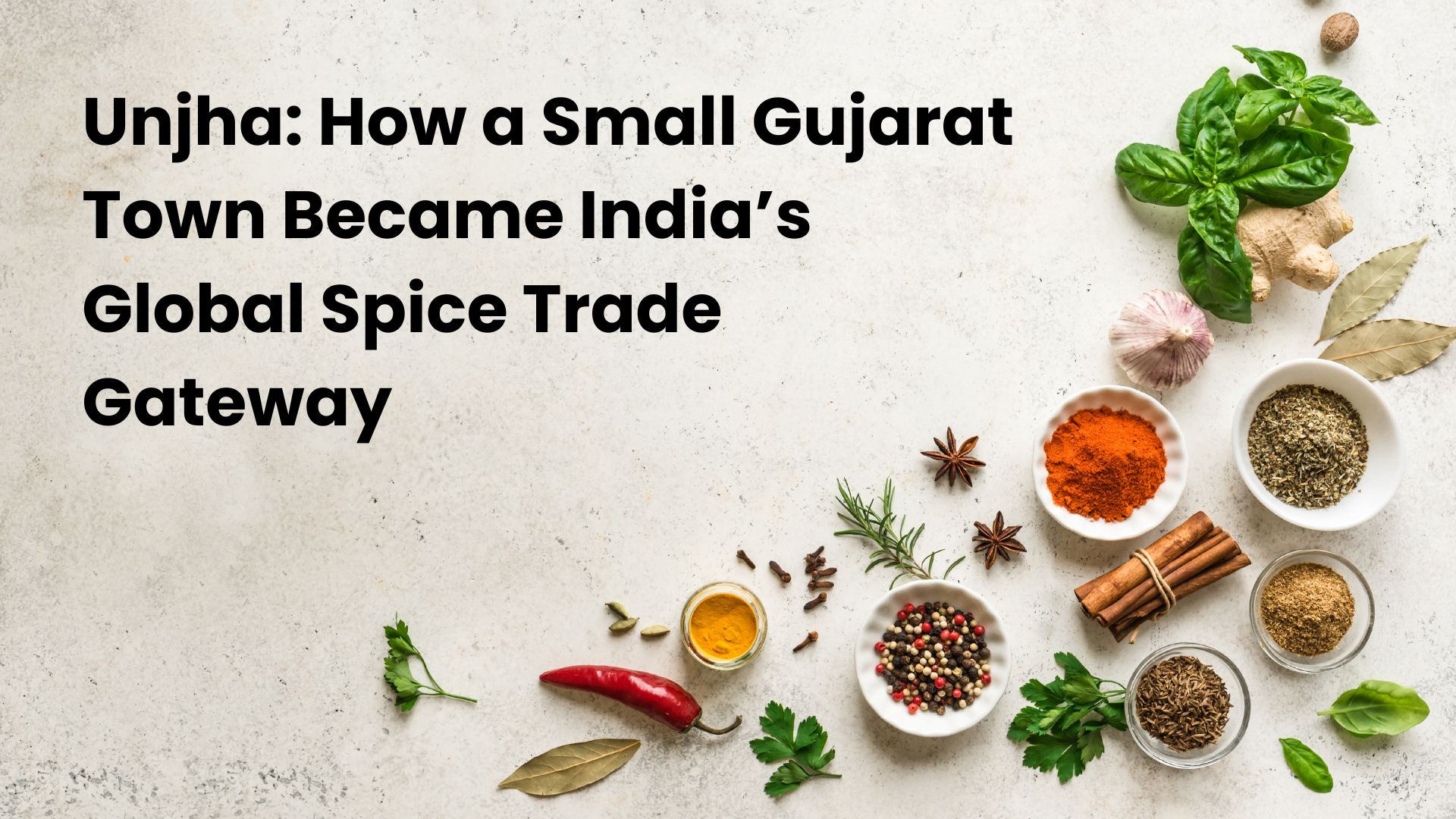
The town is a major trading hub for cumin, fennel, psyllium husk (isabgol), mustard seeds, coriander, fenugreek, ajwain and dill seeds. This diversified commodity mix has created multiple revenue streams for local enterprises while reducing dependence on a single agricultural product.
The scale of business concentrated within the town is remarkable. Industry estimates indicate that Unjha hosts nearly 400 registered spice traders and approximately 800 export-oriented business firms. Together, these enterprises form a dense commercial network that supports procurement, processing, packaging, storage, logistics and international trade.
What makes Unjha particularly relevant from an SME perspective is that value creation does not stop at commodity trading. Every truckload of spice arriving at the market generates business opportunities for a wide range of enterprises. Commission agents facilitate transactions, cleaning and grading units prepare produce for sale, packaging companies provide export-ready solutions, transporters coordinate movement, warehouse operators manage storage and exporters connect local products to global markets.
In essence, Unjha demonstrates how a cluster economy functions when hundreds of specialized businesses collectively contribute to a single value chain.
A Global Footprint Built by Local Enterprises
During FY 2024-25, cumin and other spice seeds worth approximately ₹3,995 crore were exported from Mehsana district to 101 countries worldwide. While the district encompasses multiple business centres, Unjha remains one of its most important export gateways.
The growth trajectory has been equally impressive. Export values rose from ₹2,904 crore in FY23 to ₹4,127 crore in FY24 before stabilizing at ₹3,995 crore in FY25, reflecting both strong international demand and the cyclical nature of agricultural commodity markets.
The primary export destinations include China, Bangladesh, the United Arab Emirates, the United States and Morocco. Together, these markets account for a significant share of the district’s spice exports, highlighting Unjha’s integration into global food supply chains.
The cluster’s strategic importance becomes even clearer when viewed in the broader context of India’s spice economy. Gujarat contributes nearly 80 per cent of India’s spice-seed exports, while India itself accounts for around 70 per cent of global cumin production. Few towns can claim such direct influence over an internationally traded agricultural commodity.
The Multiplier Effect of Commodity Arrivals
One of the strongest indicators of Unjha’s economic vitality is the volume of produce flowing through its markets.
Between February 15 and April 10, 2025, APMC Unjha recorded cumin arrivals of 54,410 metric tonnes, compared with 46,313 metric tonnes during the corresponding period in the previous year. The 17.5 per cent increase reflects both robust production and the market’s continuing relevance as the preferred trading destination for farmers and buyers.
For the local economy, these arrivals represent much more than agricultural output. Each consignment generates employment and revenue across multiple supporting industries. Labourers handle unloading and sorting. Transport companies coordinate movement. Packaging suppliers provide materials. Warehouse operators manage inventory. Financial intermediaries facilitate transactions. Exporters negotiate international contracts.
This interconnected structure ensures that the economic benefits of trade are distributed across a broad base of SMEs rather than being concentrated within a handful of large firms.
Infrastructure as a Competitive Advantage
Another reason for Unjha’s success lies in its strategic geography and logistics connectivity.
Situated within one of India’s largest spice-producing belts, the town naturally serves as a collection point for agricultural produce. Its proximity to rail infrastructure and access to major ports such as Mundra and Kandla strengthens its export competitiveness.
For SMEs operating in international markets, efficient logistics are often as important as product quality. Timely dispatches, storage availability, quality preservation and lower transportation costs directly impact profitability. Unjha’s ecosystem has evolved to address these operational requirements, enabling local enterprises to compete effectively in global markets.
Lessons from India’s Spice Capital
The story of Unjha offers valuable lessons for policymakers, industry bodies and entrepreneurs.
First, successful SME clusters often emerge around a dominant commercial specialization. In Unjha’s case, seed spices became the foundation upon which a broader ecosystem developed.
Second, institutions matter. The APMC provided a structured marketplace that reduced transaction friction and encouraged business growth.
Third, export competitiveness is often the result of collaboration among numerous small enterprises rather than the dominance of a few large corporations.
Finally, local identity can become a powerful economic asset. Over decades, Unjha has built a reputation that attracts traders, buyers and investors from across India and overseas.
More Than a Market
Unjha’s story is not merely about cumin, spice exports or mandi turnover. It is about how a small town leveraged specialization, infrastructure and entrepreneurship to build one of India’s most successful SME ecosystems.
In an era when policymakers are searching for scalable models of regional economic development, Unjha provides a compelling blueprint. It demonstrates that when market institutions, SMEs and supply chains work in alignment, even a modest agricultural town can evolve into a globally connected trade powerhouse.
For India’s SME sector, Unjha is not just a spice market, it is a masterclass in ecosystem building.